
A young woman from a sleepy tea garden village in Bokakhat steps off a flight at Lokpriya Gopinath Bordoloi International Airport, her neck draped with the gleaming medal from India’s first-ever Women’s Cricket World Cup victory. She’s not just any player – she’s Uma Chetry, the 24-year-old wicketkeeper-batter who made history as the first cricketer from Assam, and indeed the entire Northeast, to lift that trophy. Just a day earlier, she’d been shaking hands with Prime Minister Narendra Modi in Delhi, beaming under the national spotlight. But back home in Assam, the welcome? A handful of reporters , a few airport staffers in uniforms, two ACA officials and members of local Gorkha groups with gamosa that wilted faster than the excitement. No red carpet. No cheering crowds. No state band blaring victory tunes. And certainly, no BJP minister to say, “Well done, beta.”It’s the kind of story that sticks in your throat like a lump of overcooked rice – equal parts heartbreaking and infuriating.
Uma Chetry’s arrival on the evening of November 6 should have been a parade of pride, a moment for Assam to wrap its arms around one of its own and shout to the world: “Look what we’ve got!” Instead, it turned into a damning indictment of the BJP-led government’s priorities. Why, in a state that loves to thump its chest about “developed India” and “women empowerment,” was this athlete left to fend for herself? And why are the excuses pouring in now – from finger-pointing at the BCCI to shrugs of “we weren’t informed” – ringing so hollow?
Let’s rewind a bit to understand just how monumental Uma’s achievement is. 
Born in 2001 to Lok Bahadur Chetry, a simple farmer battling high blood pressure and diabetes, and his wife Dipa, a homemaker who juggled household chores with dreams of her daughter’s future, Uma grew up in Kandulimari village under the shadow of the mighty Brahmaputra. Floods were a yearly uninvited guest, washing away not just homes but hopes. As a kid, Uma once lost her shoes to the swirling waters, practicing her swing with a plastic bat on muddy fields while her peers chased butterflies.
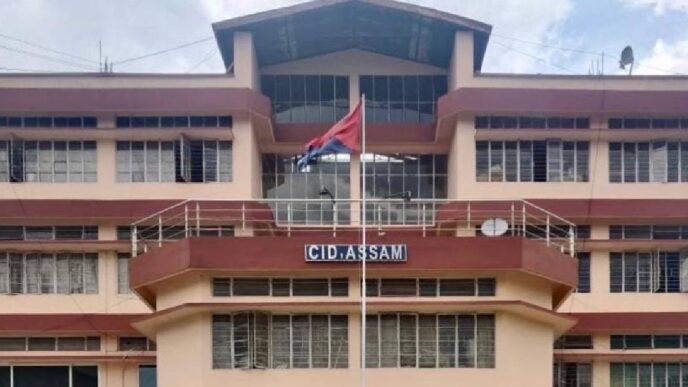
Uma always had fire in her belly. She’d mimic the TV stars, keeping wicket till the stars came out.”That fire took her from local dusty pitches to the Assam Cricket Association (ACA) nets, where coaches like Dr. Manju C. Das spotted her raw talent. By 2023, Uma was the first Assamese woman in the Indian squad, earning a Rs 5 lakh cheque from the ACA – a gesture led by none other than Taranga Gogoi, the very BJP MLA from Naharkatia who’s now at the center of this mess as ACA president. She shone in the Women’s Premier League for UP Warriorz, pocketed a BCCI Grade C contract worth Rs 10 lakh annually, and then, in the 2025 World Cup co-hosted by India and Sri Lanka, she became part of the squad that crushed South Africa in the final at DY Patil Stadium in Navi Mumbai.
Her debut? Right there in Guwahati’s Barsapara Stadium against Bangladesh – though rain played spoilsport, the roar of the crowd (meager as it was) echoed her promise. Captain Harmanpreet Kaur called her “a rock behind the stumps,” and vice-captain Smriti Mandhana gushed about her work ethic. This wasn’t just a win for India; it was Assam’s win, a Gorkha girl’s win, a Northeast win in a sport long dominated by metros.So, when Uma touched down in Guwahati after the PM’s felicitation – an event splashed across national headlines – you’d think the state machinery would be revved up.
Other players from the victorious squad got hero’s welcomes back home: Jemimah Rodrigues was mobbed in Mumbai with fireworks and school kids waving banners; Deepti Sharma’s Uttar Pradesh rolled out the red carpet at Lucknow airport with the chief minister himself handing over keys to a new flat.
But in Assam? Crickets. Literally. Uma slipped out quietly, heading straight to Bokakhat where villagers and family waited with homemade sweets and tears. By the next morning, social media was ablaze. Hashtags like #JusticeForUmaChetry and #AssamShameOnYou trended, with thousands sharing grainy airport clips showing her smiling politely amid the sparse group.Enter the blame game, stage left. Taranga Gogoi, the BJP’s golden boy in cricket circles – re-elected unopposed as ACA president just last month – was quick to wash his hands. In a statement , he pointed fingers squarely at the Board of Control for Cricket in India (BCCI). “We weren’t given proper information about her arrival schedule,” he told reporters on November 7, his voice steady but eyes darting.
“The BCCI handles national team logistics; as an affiliated body, we rely on them for cues. Had we known earlier, the ACA would have rolled out the welcome mat.” It’s a line that’s as convenient as it is questionable. Really, Taranga? The ACA, under your watch, has groomed Uma from her under-19 days, felicitated her milestones, and even pushed for more women’s cricket infrastructure. You’re not some backbench affiliate; you’re the bridge between state pride and national glory, with BCCI Secretary Devajit Saikia – another Assamese – just a phone call away. If the PMO could track Uma for a Delhi meet-and-greet, couldn’t a simple heads-up from the BCCI’s inner circle reach Guwahati? Or is it that in the rush to blame outsiders, you’ve forgotten your own backyard?Gogoi’s excuse doesn’t just crumble under scrutiny; it raises eyebrows about accountability. As a BJP MLA since 2021, he’s supposed to embody the party’s “Sabka Saath, Sabka Vikas” mantra. Yet here he is, shifting responsibility to the very organization ACA reports to, like a schoolkid blaming the teacher for unfinished homework.
Critics, including Congress MP Gaurav Gogoi (no relation to Taranga), called it out sharply on X: “An opportunity lost. The Chief Minister… is busy saying childish things in Jharkhand.” Gaurav’s post, viewed over 40,000 times, painted a vivid picture: Uma, from a “simple family in Bokakhat,” deserved better coordination from “BCCI Secretary and Chairman Assam Cricket Association.” And he’s right – why wasn’t there a joint protocol? Past World Cup heroes like the 1983 men’s team got state dinners; even local stars like Hima Das were feted with cash prizes and statues. Taranga’s lame pivot to the BCCI feels less like oversight and more like optics – protecting the government’s image while dodging the real question: Where were you?
Then there’s Sports and Youth Welfare Minister Nandita Garlosa, whose response added fuel to the fire. Speaking to Northeast Scoop on November 7, she admitted, “Had we been informed, we would have definitely gone to welcome her.” It’s a line that’s equal parts empathetic and exasperating.
Nandita, with all due respect, isn’t the PMO’s intern – you’re the minister in charge of Assam’s sporting soul! The World Cup final wrapped on November 2; headlines screamed Uma’s name by November 3. The Assam government’s media cell monitors national news like hawks – they tweet about everything from flood alerts to yoga days. And Uma? She met the Prime Minister on November 5, a fact broadcast on Doordarshan and every Assamese channel worth its salt. Yet, your department claims a black hole of information? It begs the question: Is the BJP government’s sports machinery so tuned out that it misses its own homegrown champion, fresh off a PM handshake?This isn’t just sloppiness; it’s symptomatic of deeper rot.
Whispers in Bokakhat and Guwahati point to Uma’s Gorkha roots – that surname “Chetry” evoking Nepal’s hills more than Assam’s plains. Assam’s politics has long simmered with ethnic undercurrents, from NRC rows to anti-CAA protests, where communities like the Gorkhas often feel sidelined. “If she were from a different community, with a name that sounded more ‘Assamese,’ would ministers have queued up at the airport?” asks Sunil Chetri, president of the All Assam Gorkha Students’ Union, who was among the few to greet Uma that night. “This feels like quiet discrimination, masked as forgetfulness.”
It’s a charge the BJP can’t brush off easily. The party, which swept to power in 2016 promising inclusive growth, has faced flak for favoring certain ethnic narratives while marginalizing others. Remember the 2023 evictions in Darrang, where Bengali Muslims bore the brunt? Or the stalled Gorkha autonomous council demands? Uma’s snub fits a pattern – celebrate the win nationally, but whisper doubts locally if the hero doesn’t fit the mold.The outrage boiled over by November 7. Hundreds thronged Uma’s Bokakhat home, turning the dirt road into a sea of tricolors and placards. Schoolgirls in pigtails chanted her name, while elders pressed envelopes of savings into her hands – a folk heroism the government couldn’t muster.
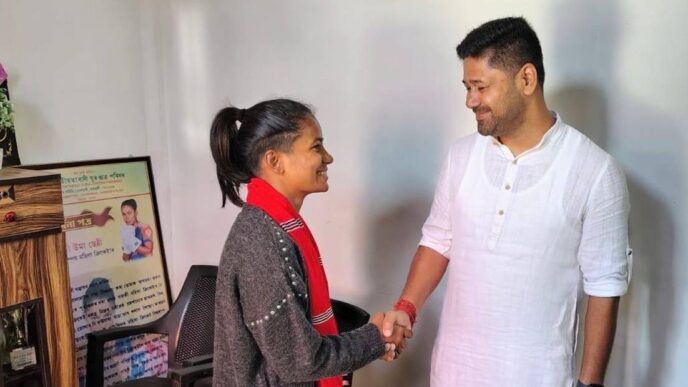
Social media amplified it: Aman Wadud, a prominent lawyer and INC spokesperson, tweeted, “Assam’s Champion daughter deserves better!” racking up hundreds of shares. The Assam Congress piled on, posting side-by-side images of political VIPs getting airport fanfare versus Uma’s lone silhouette. Even neutral voices, like sports journalist Aboyob Bhuyan, noted the hypocrisy: “Women’s Cricket was not discussed so much in Assam as it has been criticised today.” By evening, damage control kicked in. Minister Garlosa rushed to Bokakhat for a belated visit, posing for photos with Uma and promising “all support.” Taranga Gogoi announced a “grand felicitation” for November 9 at the ACA Stadium – better late than never, but why the scramble now?What should have happened? Let’s dream it out, because Assam deserves to.
The chief minister, Himanta Biswa Sarma – who’s not shy about photo-ops – cutting a ceremonial cake emblazoned with “Uma: Assam’s Pride.” School bands from Golaghat to Dibrugarh piping in, young girls in jerseys holding “Future Umas” signs. A motorcade to Barsapara, where the pitch she debuted on becomes a stage for speeches: Taranga recounting her ACA journey, not as an afterthought but as a badge of honor. Cash prizes – say, Rs 50 lakh from the state, matching what male stars get – scholarships for Gorkha girls in sports, a dedicated training center in Bokakhat named after her. And yes, community leaders from every nook of Assam – Bodo, Karbi, Mising, Ahom – joining in, turning it into a tapestry of unity. That’s the welcome a World Cup winner earns, not excuses wrapped in red tape.Uma, bless her grounded heart, isn’t one for grudges.
Speaking to villagers on November 7, medal glinting in the afternoon sun, she said, “I’m just happy to be home. The real win is seeing my ma’s face light up.” Her mother Dipa added, “We’ve faced floods and doubts, but Uma showed us dreams float higher.”
The BJP government, with its tall talk on “Beti Bachao, Beti Padhao,” has a mirror to gaze into here. Taranga Gogoi’s BCCI blame? It’s a dodge that undermines the ACA’s own legacy. Minister Garlosa’s “not informed”? A cop-out from a department meant to be proactive, not passive.As the November 9 event looms, one hopes it’s more than makeup. Assam’s daughters – Gorkha, Bodo, Dimasa, or otherwise – shouldn’t have to fight for flowers after fighting for the country. Uma Chetry isn’t just a cricketer; she’s a mirror reflecting what we value. Right now, that reflection looks a bit tarnished. But with voices rising from Bokakhat to Delhi, perhaps it’s time to polish it. After all, in the game of life, every hero deserves a standing ovation.