

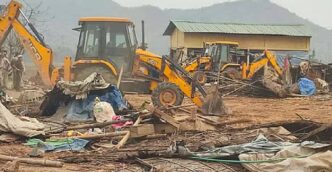
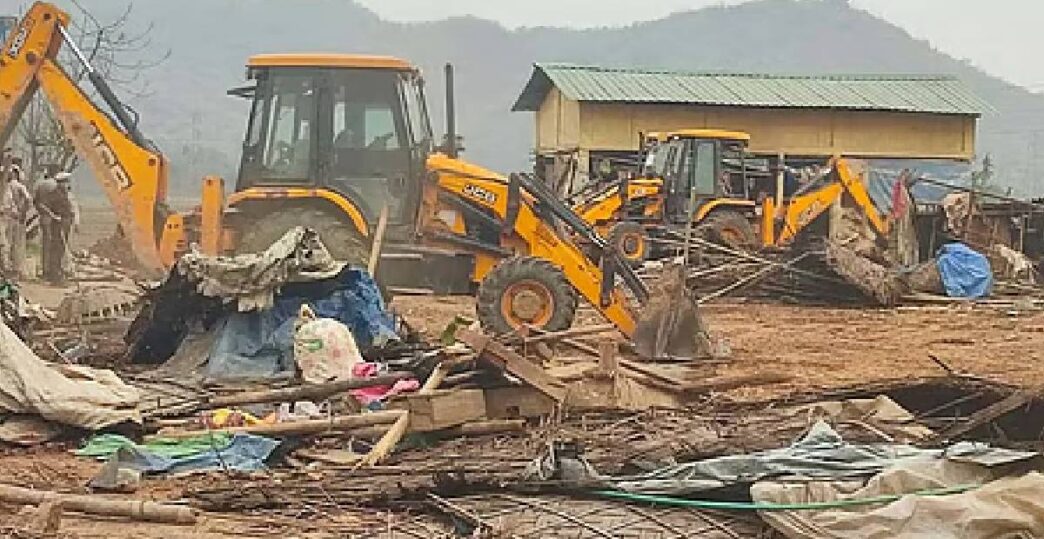
The Nagaon district administration plans a sweeping eviction drive “very soon” targeting around 19,709 bighas of government land, according to District Commissioner Debashish Sharma. He said that this land, much of which once formed part of Assam’s reserve forest in the 1800s and early 1900s, is government property and cannot remain under illegal occupation.
Sharma insisted that the administration is not in the business of indiscriminate demolitions. “We are not breaking anybody’s house,” he said, “we are just vacating government property.” Notices were issued roughly two months ago, giving occupants time to leave. He claimed the administration acted on “humanitarian grounds” and appealed for voluntary evacuation but now, according to officials, the grace period has ended.
The embattled land isn’t limited to one area. Encroachments have been identified across several revenue circles: Raha, Kaliabor, Kampur, Rupahihat, Samaguri, Dhing and more. 
According to data, Raha alone accounts for 4,381 bighas, while Kaliabor has about 1,000 bighas under illegal occupation.
But the scale of encroachment goes far beyond these tens of thousands. As per the Assam Tribune, the state government’s own figures reveal 1,90,710 bighas of government land in Nagaon are under encroachment spread over multiple categories such as grazing land, revenue land, and forest land.
This raises a sharp question: if such a large area is officially encroached, why has action been so limited or delayed?
Critics argue that the administration’s plan, while presented as law enforcement, lacks clarity on rehabilitation. What will happen to the families that have lived there for years even decades? Many encroachers claim they are long-time residents who have settled informally, with no clear legal title.
If the district reclaims this land, will it provide alternate land or compensation, or will people simply be left to fend for themselves?
Further complicating matters, eviction notices have already begun in some circles. In Samaguri, for example, authorities have ordered residents of Belguri Kachari village (Khatowal mouza) to vacate government grazing reserve lands.
In earlier phases too, some families left voluntarily in areas like Balikotia and Jengoni under Dhing circle a move the administration praised.
But voluntary exit from a few pockets cannot resolve the larger issue. With nearly 1.9 lakh bighas under occupation and only limited portions being reclaimed so far, observers ask: Is this just a token drive to show action or is there a serious, sustainable plan to restore land while protecting the rights of vulnerable people?
District Commissioner Sharma’s warning that “families failing to vacate voluntarily will face forcible eviction” adds urgency. The coming days are likely to be tense: for the administration pushing to reclaim land, and for the residents many of them poor who risk losing their homes.
At stake is more than just land. It’s a test of whether the government can balance rule of law and humanity, or whether the powerful drive for reclamation will leave ordinary people with nowhere to go.