

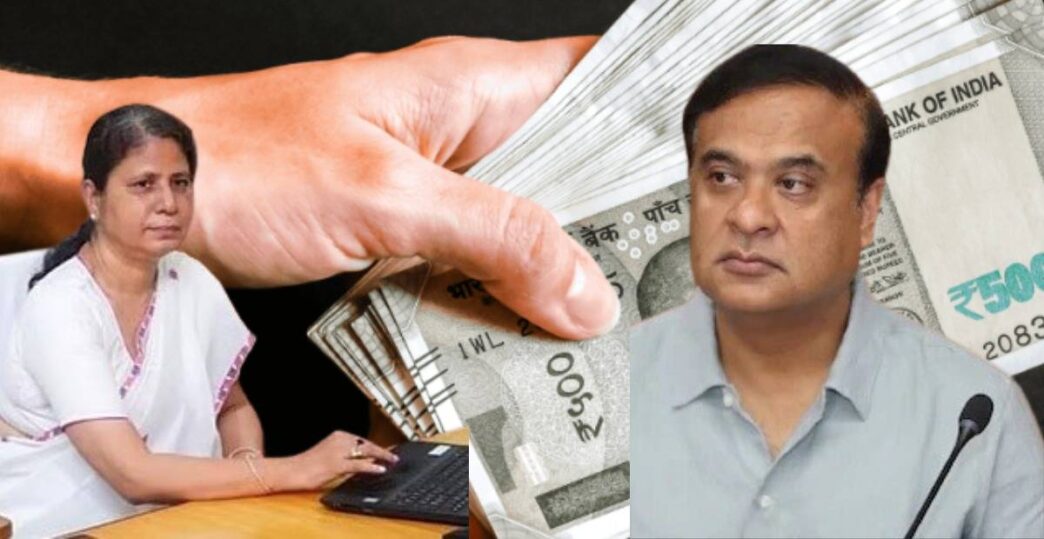
For many families in Assam, the debt they carry today is higher than their annual income. By March 2025, the state’s total debt reached over Rs 1.62 lakh crore, which means each person from a tea garden worker in Dibrugarh to a small shopkeeper in Guwahati carries a debt of about Rs 51,000. This isn’t a small loan for a car or house; it’s a huge amount borrowed by the government in our name and it’s growing fast.
This isn’t just numbers on a page. It’s a crisis that’s hitting hard at the heart of Assam’s dreams. Schools without enough teachers, hospitals short on medicines, roads full of potholes ; all because more and more of our tax rupees are going to pay interest on loans instead of building a better future. And who’s to blame? The Himanta Biswa Sarma-led BJP government, which came to power promising “double engine growth” but has instead revved up a debt engine that’s sputtering toward disaster. Fiscal mismanagement, flashy welfare schemes without solid funding, and a blind eye to rising costs have turned Assam’s finances into a house of cards. As opposition leaders cry foul and economists sound alarms, it’s time for the common man to ask: How much longer can this go on before it all comes crashing down?
Let’s break it down simply. Assam’s economy, measured by its Gross State Domestic Product (GSDP), was estimated at Rs 6.44 lakh crore for the financial year 2024-25. That’s the total value of everything we produce and sell in the state from oil and tea to tourism and handicrafts. On paper, it sounds impressive, with the government boasting a 15% growth jump to Rs 7.42 lakh crore in 2025-26. 
But dig a little deepe and the shine fades. The state’s outstanding liabilities basically, all the money it owes stood at 25.2% of GSDP by March 2025, up from 24.3% the year before.
That translates to Rs 1.62 lakh crore in total debt, a staggering jump from Rs 1.15 lakh crore in March 2023.
To put it in perspective, that’s like every family in Assam owing Rs 2 lakh enough to buy a small plot of land or send a child to college for years. With Assam’s population hovering around 3.2 crore, the per capita debt works out to roughly Rs 51,000 per person.
And it’s not stopping. Under the current regime since 2021, the state has added at least Rs 61,191 crore to its debt pile in just over three years, according to Reserve Bank of India data.
Congress leaders aren’t mincing words: they’ve slammed the government for ballooning the debt to Rs 1.52 lakh crore by late 2024 and demanded a white paper to explain this mess.
How did we get here? Start with the basics: money in versus money out. In 2024-25, the state collected Rs 1.12 lakh crore in revenue receipts that’s taxes, central grants and other income.
Sounds decent, right? But total spending ballooned to Rs 1.69 lakh crore leaving a gaping hole.
The fiscal deficit, the amount by which spending outstrips income hit Rs 37,005 crore, or a whopping 5.7% of GSDP. For context, the national rulebook (Fiscal Responsibility and Budget Management Act) caps it at 3% to keep states from going overboard. Assam blew past that limit like a flood breaking a dam.
Even worse is the revenue deficit: Rs 5,368 crore in 2024-25, meaning the government couldn’t even cover day-to-day costs like salaries and pensions without dipping into borrowings.
Revenue spending alone on things like education, health, and police was Rs 1.18 lakh crore, while capital outlay (building roads, schools, bridges) got just Rs 33,897 crore.
That’s backward. You can’t grow an economy by paying bills but skimping on investments. And the cherry on top? Interest payments on old loans ate up Rs 9,687 crore almost 9% of total revenue leaving less for everything else.
By 2025-26, that’s projected to climb to Rs 10,987 crore, a 13% hike.
The government’s borrowing spree tells the real story. In 2023-24, it raked in Rs 44,014 crore through loans. For 2024-25, the revised estimate shot up to Rs 43,330 crore that’s fresh debt to plug holes from the year before. Public debt receipts alone were Rs 23,368 crore, per official finance department figures. Finance Minister Ajanta Neog, who tabled the Rs 2.63 lakh crore budget for 2025-26 in March, patted herself on the back for keeping the deficit at a “manageable” Rs 15,354 crore (3.7% of GSDP). But, the budget slashed capital spending by 13% from last year’s revised estimates, signaling a squeeze on growth projects.
Why is this happening? Blame a mix of bad luck and worse decisions. Assam’s economy relies heavily on agriculture (27% of GSDP), tea, oil and natural gas sectors hit hard by climate change, floods, and global price swings. The 2022 floods alone wiped out Rs 5,000 crore in damages, forcing emergency borrowings. But the government’s real sin is fiscal mismanagement. Populist schemes like the Orunodoi cash transfer (Rs 1,000 monthly to poor women) and free electricity for farmers sound great and won votes but they’re funded by loans, not new taxes or efficiencies.Take revenue collection: Own tax revenue grew just 4% to Rs 1.17 lakh crore in 2025-26, lagging behind the 15% GSDP growth claim.
Why? Poor enforcement, evasion, and over-reliance on central handouts (Rs 56,000 crore in 2024-25 grants).
Meanwhile, expenditure on salaries and pensions jumped 20% in recent years, bloated by new hires and hikes without matching productivity gains. Economists point to “leakages”, corruption and inefficient spending as a silent killer. A NITI Aayog report notes Assam’s contingent liabilities (guarantees on public sector loans) are low at 0.1% of GSDP, but that’s cold comfort when core debt is exploding.
Chief Minister Himanta Biswa Sarma defends it all. “Assam’s debt-to-GSDP is just 25%, lower than 18 other states,” he tweeted in March highlighting 17 public sector undertakings turning profits. In October 2024, he shot back at opposition claims, saying Assam ranks “bottom-most” in central borrowings. The budget speech under Neog’s name tells this: borrowings are “strategically focused on capital expenditure,” not waste.
They claim the state has grown fast even doubling its GSDP since 2016 and say peace accords have lowered militancy costs. But without proper financial discipline, this growth is shaky. By July 2025, Assam’s debt had risen to Rs 1.84 lakh crore, pushing the debt ratio to 25.2%, above the recommended 20% limit according to opposition petitions in the Gauhati High Court.
The real victims? You and me. This debt bomb is already exploding in daily life. In health, Assam spends just 5.5% of its budget (Rs 8,200 crore in 2025-26), down in real terms after inflation which means longer waits at government hospitals and fewer vaccines for kids.
Education gets 15% (Rs 22,000 crore), but teacher shortages persist, with 20,000 posts vacant.
Roads and irrigation? Capital outlay cuts mean more floods swallowing villages. And interest payments? That’s money not going to flood relief or job schemes.
If growth slows (as floods or global oil dips could cause), we’re staring at a Greece-style crisis: higher taxes, slashed services, maybe even IMF-style bailouts. Opposition Leader Debabrata Saikia urged the High Court in August to probe “financial irregularities,” warning of a “escalating debt crisis.”
Even neutral watchers like PRS Legislative Research flag the 5.7% deficit as “worrisome,” urging better revenue mobilization.
So, what now? The government must stop the blame game and act. Cut wasteful spending like the Rs 500 crore annual losses in state enterprises, as Sarma himself admitted.
Boost own revenues by plugging tax holes and investing in tourism or agro-processing. And transparency: That white paper Congress demands? Publish it, show the books. For the common Assamese, drowning in this debt deluge, the message is clear: Demand accountability. Before the loans we never asked for sink our state forever.