

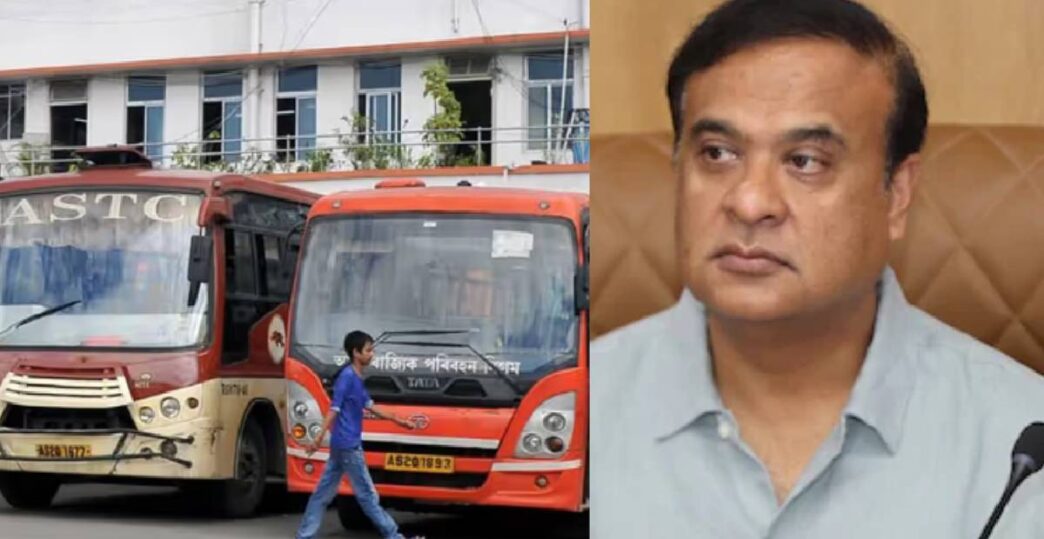
The latest audit by the Comptroller and Auditor General of India has delivered a hard jolt to the public conscience in Assam. The CAG’s Report No. 4 of 2024 exposes a catastrophic financial collapse within the Assam State Transport Corporation, revealing how the state-run entity has deteriorated into the single largest drain on public funds among all statutory bodies in the state. The figures are not just alarming; they represent a complete failure of governance, accountability and financial discipline under the present political leadership.
According to the CAG, ASTC recorded a loss of Rs. 106.53 crore in the financial year 2022–23 alone. Even more troubling is the accumulated loss figure, which now stands at an unprecedented Rs. 1,664.06 crore. This means ASTC is responsible for a staggering 97.63 per cent of the total accumulated losses of all statutory corporations in Assam. In effect, nearly every rupee lost by statutory bodies in the state is being swallowed by one entity that continues to function without meaningful reform, public transparency or measurable improvement. These numbers are not estimates or projections; they are drawn directly from audited financial statements and represent one of the sharpest indictments a public-sector enterprise can receive.
Despite this unending financial decline, ASTC has continued to survive on taxpayer money. Over the past three years, the Assam government has infused a total of Rs. 370.01 crore into ASTC through grants and subsidies. Instead of using these funds to correct structural weaknesses, modernise fleet operations, overhaul maintenance systems, introduce accountability, or create a sustainable revenue model, the corporation has consistently absorbed this money without demonstrating any financial or operational turnaround. The CAG’s findings make it unequivocally clear that public funds have been poured into a bottomless pit that shows no signs of recovery. 
The Himanta Biswa Sarma-led government has projected itself as financially disciplined, reformist and performance-oriented. However, ASTC’s financial condition tells a very different story. Continuing to inject hundreds of crores into a corporation that has no credible business revival plan amounts to fiscal negligence. The CAG has pointed out that much of this money has been used merely to meet recurring deficits instead of being channelled into strategic improvement. This effectively means taxpayers are funding losses year after year without receiving improved services or accountability in return. At a time when Assam requires investments in healthcare, education and infrastructure, the government’s decision to continue subsidising a chronically mismanaged corporation raises serious concerns about its priorities.
The social cost of ASTC’s failure is equally severe. Public transport is a lifeline for lakhs of citizens across rural and urban Assam. Students, office workers, daily wage earners and economically weaker groups depend on ASTC for affordable mobility. When the corporation fails, the people pay the price through reduced services, unreliable routes, deteriorating buses and increased private-sector dependence. A public utility that should serve the people has instead become a massive fiscal liability, undermining both public trust and service delivery.
The CAG report also highlights deeper governance issues that have contributed to ASTC’s downfall. Delayed accounts, weak financial oversight and the absence of structural reforms have allowed inefficiencies to persist unchecked. While other sectors in India are moving toward modernisation, digitalisation and transparent financial management, ASTC has been left behind due to a lack of vision and political will. The corporation’s performance has not merely stagnated; it has actively deteriorated at a time when the state claims to be advancing in every direction.
The political implications of the CAG report cannot be ignored. This is not a crisis inherited solely from past administrations. The current government has been in power long enough to implement reform, enforce accountability and demand performance from loss-making public enterprises. Instead, it has allowed ASTC to continue operating in the same broken manner, propped up by constant public funding. The infusion of Rs. 370 crore into an entity that continues to post massive losses without any corrective action raises legitimate questions about fiscal responsibility and transparency within the administration.
ASTC’s case demonstrates that the government’s approach to public-sector management has prioritised temporary financial injections over systemic reform. The money spent has not translated into better services, better governance or better returns. The CAG’s findings demand a serious political and administrative response, not superficial assurances. A thorough restructuring of ASTC is no longer optional; it is a necessity if the government intends to protect public money and restore public trust.