

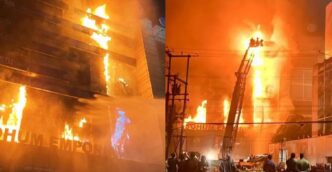
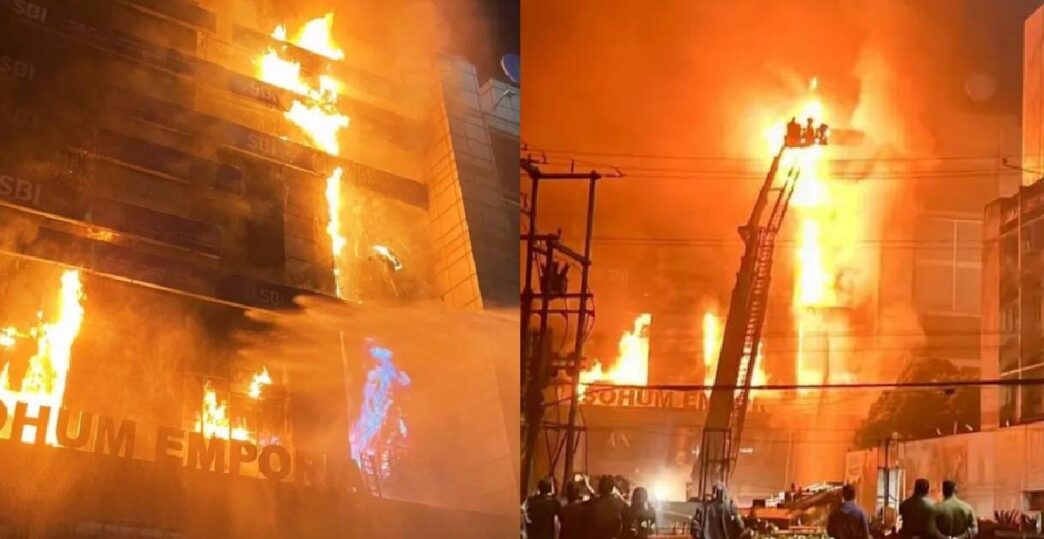
A major fire in the multi-storey Swagata Square building in the ABC area of Guwahati has continued for almost 40 hours, and even now, officials cannot say what exactly caused the blaze. The long struggle to control the fire has raised serious questions about how safe high-rise and commercial buildings in the city really are, and whether the city is prepared for such emergencies at all.
The fire started late on Tuesday night and spread quickly through the building. Fire officials said it first began on the second floor, where a godown of the shopping mall stored a large amount of clothes and other inflammable items. Once the flames caught these materials, thick smoke filled the building and made it very difficult to enter. Goods worth crores are feared to be destroyed.
More than 25 fire tenders have been fighting the flames continuously. Fire tenders from the Indian Army, Indian Air Force, and Guwahati Refinery were also brought in. Teams from Morigaon, Kamrup, Nalbari, and Darrang districts rushed to Guwahati to help as the situation worsened. The NDRF also joined the operation with a smoke reduction machine. Even with all these efforts, the fire remained strong on the upper floors till Wednesday night and into Thursday morning. 
Thankfully, no loss of life has been reported. Only one firefighter suffered minor injuries and is being treated at GMCH.
However, what was seen during the operation has worried many people. Fire tenders could not reach the backside of the building at all. There was no approach road, so teams could only attack the fire from the front. This slowed down the work and allowed the flames to burn deeper for many hours. Residents and officials have now started asking how such a large commercial building was approved without proper fire safety arrangements.
Swagata Square is located in a crowded area, next to a busy traffic point and close to the Bhangagarh flyover. During peak hours, it was difficult even to position the fire vehicles properly. Officials from the Assam State Disaster Management Authority said that the first hours were the most difficult because the smoke was so dense that firefighters could not enter safely. By the time they managed to go inside, the fire had already gained strength.
The incident has also brought attention to how building safety norms are often ignored. Under the National Building Code, commercial buildings must have clear fire exits, sprinklers, hydrant systems, alarm systems, and proper access for fire tenders. But in many cases, these rules remain only on paper. After every major incident, officials find the same problems; blocked exits, overloaded wiring, storage in basements, and poor maintenance of equipment.
Many people are now asking if Guwahati has more buildings that are at similar risk. Areas like Ganeshguri, Christian Basti, Fancy Bazar, and Maligaon have many high-footfall commercial centres, but safety checks are rarely visible. In several of these places, electric cables hang loosely, and basements are used as storage spaces filled with inflammable items. Old residential buildings also remain unsafe as they were never designed for today’s heavy electrical load.
For a city that is growing fast and building vertically, the Swagata Square fire has acted as a strong warning. If one building can burn for 40 hours and the cause still remains unknown, it becomes important for the Guwahati Municipal Corporation, GMDA, and the Fire & Emergency Services department to carry out real, ground-level audits. People visiting these buildings daily also deserve clear information about whether the structures they enter are safe.