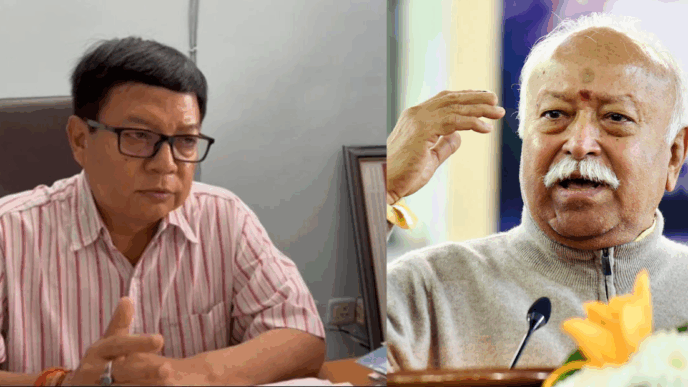


Leader of the Opposition in Assam and senior Congress leader Debabrata Saikia has strongly criticised the BJP-led government, alleging that the Special Revision (SR) of the voter list is being used as a tool to change the demography of the state. Saikia said the process is posing a serious threat to the identity and political future of the indigenous people of Assam.
Saikia claimed that during the ongoing Special Revision exercise, large numbers of people from states like Bihar and Uttar Pradesh are being added to the voter list in Assam. He alleged that BJP leaders are using SR as a political strategy to expand their vote bank at the cost of local communities.
He said that instead of completing the upgrade of the National Register of Citizens (NRC) based on the Assam Accord, the government is now pushing the SR process aggressively. According to him, the NRC was meant to identify foreigners who entered the state after 24 March 1971. However, he alleged that while the NRC excluded around 19 lakh people, the BJP government has now started adding new and unknown names to the voter rolls. 
Saikia said that Congress leader Rahul Gandhi had already raised this issue publicly, cautioning that the voter revision process may be misused. Despite this warning, Saikia alleged that neither the Election Commission nor the state government has taken any meaningful steps to address the concerns raised.
He further claimed that due to administrative pressure surrounding the revision work, Booth Level Officers (BLOs) are facing mental stress. According to him, this pressure has even resulted in some tragic incidents.
The Congress leader termed the BJP’s political approach as a form of “Hindutva imperialism” and said that the push for a “one country, one language” idea is harmful for Assam’s culture, language and the rights of indigenous communities. Saikia said the time has come for the people of Assam to stay alert and united to protect their identity.
He said that Assam does not need what he called a “burden-creating SR process”. Instead, he said, the priority should be a clean and foreigner-free NRC, implemented strictly according to the Assam Accord.
Saikia clarified that Congress has never opposed welfare schemes like the “orunodoi” programme. He said the Direct Benefit Transfer (DBT) system used for such schemes was first developed during the Manmohan Singh-led UPA government. However, he took objection to what he termed as the “hypocrisy” of Chief Minister Himanta Biswa Sarma.
He recalled that during the Sarbananda Sonowal government, Himanta Biswa Sarma, who was then a minister, had once quoted a Chinese proverb saying that teaching a person how to fish is better than simply giving fish to eat. Saikia said the same leaders are now doing the opposite by focusing mainly on cash transfers rather than helping people become self-reliant.
Referring to earlier Congress-era schemes such as the Family Oriented Income Generation Scheme (FOIGS), Saikia said those programmes aimed to support families in building livelihoods. In contrast, he accused the present government of concentrating only on beneficiary-driven politics and closing down production-oriented schemes.
He also raised questions about the financial assistance of Rs 1,250 given under the government’s welfare plans. Saikia asked why the government has failed to control rising prices of essential commodities if it truly wants to help poor families. According to him, families are struggling with inflation while the government focuses mainly on distributing small amounts of money.
Saikia also criticised the timing of financial disbursements, questioning why the money is held back in January but released together in February. He claimed that this timing is linked to electoral calculations rather than public welfare.
With the festival of Bhogali Bihu approaching, Saikia said the people of Assam should not be left struggling to manage their daily needs while political decisions are taken with elections in mind. He said that while helping the poor is important, their dignity and emotions must be respected and they should not be treated as mere “beneficiaries”.