
The debate over what really caused the death of beloved Assamese singer Zubeen Garg has intensified after MLA Akhil Gogoi made public parts of what he says is the Special Investigation Team’s (SIT) chargesheet. For months, there were questions in Assam about whether the incident was an accident or whether negligence or intent led to the tragedy. With the partial Assamese translation of sections of the chargesheet now circulating on social media, under Case No. 14/2025, the public has gained a first look at what investigators claim is the basis of the ongoing probe.
This raises a core question: On what evidence is the investigation into Zubeen’s alleged murder being conducted? And what documentation links the prime accused: Siddharth Sharma, Amritprabha Mahanta, Shekharjyoti Goswami, Shyamkanu Mahanta, and Sandipan Garg to the final events leading to the singer’s death?
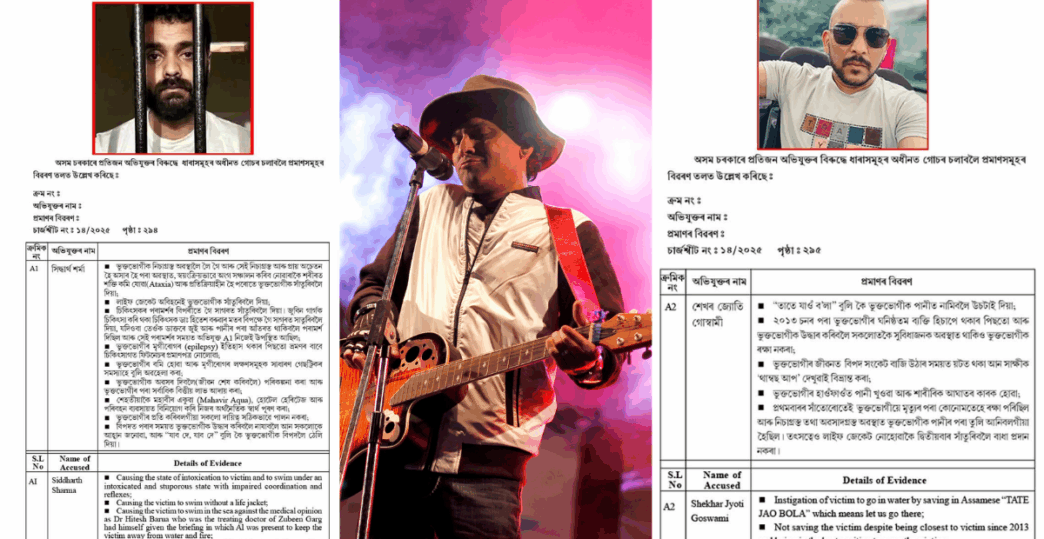
According to portions of the translation posted by MLA Akhil Gogoi, the SIT has built its case around eyewitness testimonies, recorded communications on the yacht, medical history, actions taken before entering the water, and decisions that allegedly placed the victim in danger. The type of evidence highlighted in pages 224 and 235 of the chargesheet suggests that the investigation relies heavily on negligence, instigation, suppression of information, and possible financial motives. 
One of the most detailed accusation sections concerns Siddharth Sharma. The chargesheet excerpts describe the victim being placed in a condition of intoxication and semi-consciousness. The SIT alleges that Siddharth ignored visible signs of impaired coordination and muscle weakness. It is written that instead of offering support or discouraging dangerous activity, Siddharth pushed the victim toward swimming.
Investigators further claim that he instructed a lifeguard present on the yacht not to intervene, even when the situation was deteriorating. This raises serious questions about intent and responsibility. The translated portion mentions that no medical fitness certificate was obtained prior to travel, even though the accused was allegedly aware that the victim suffered from epilepsy. Doctors’ warnings about avoiding water-related activities without precautions were reportedly ignored.
The chargesheet describes negligence in safety protocols related to epilepsy. Normally, physicians advise strict observation, rest, and avoidance of triggers when patients are travelling. Yet, investigators claim Siddharth did not obtain medical approval and continued with planned travel, yacht boarding, and swimming activities.
Another allegation recorded in the excerpt is that Siddharth had knowledge of the victim vomiting, but dismissed it as mere gastric discomfort rather than a warning sign connected with epilepsy. According to the SIT, there is evidence suggesting the accused disregarded clear medical danger signals.
Investigators also mention financial angles involving Mahavir Aqua, hotel investments, and travel-related business connections. Documents referred to in the chargesheet allegedly show planning for financial benefits linked to the victim’s earnings and business interests. While intent will need to be proven in court, such records raise questions about possible motives that go beyond recklessness.
Perhaps the most striking language in the translation is the reference to Siddharth repeatedly saying in Assamese, “Jabo De, Jabo De” meaning “let him go.” Witnesses quoted in the excerpt say these words were spoken when attempts were being discussed to help the struggling victim. If found credible, such statements could be significant, as they suggest discouragement of rescue rather than panic or shock.
The second detailed excerpt posted by Gogoi concerns Shekharjyoti Goswami. The SIT claims he verbally instigated the victim to enter the water by saying “Tate Jao Bola,” translated as “let us go into the water.” The chargesheet text describes Shekhar as a long-time travel companion of the victim, since 2013, who was fully aware of the singer’s health conditions and distress signals during the incident.
Investigators allege that he discouraged the placement of safety systems on board the yacht and reduced access to emergency equipment. The translation claims that during the distress period, he signaled a thumbs-up to avoid suspicion, even though the victim was in visible trouble in the water.
The SIT notes that by statements and inaction, Shekhar allowed ingestion of water and continued bodily harm to occur. The excerpt describes the absence of a life jacket, despite repeated warnings and physical weakness shown by the victim. After the death, Shekhar allegedly concealed critical information, including the lack of a life jacket and ignored medical advice. The chargesheet suggests attempts to control the narrative immediately after the incident.
While the posted excerpts focused on Siddharth and Shekhar, MLA Gogoi stated that similar allegations exist against the remaining accused: Amritprabha Mahanta, Shyamkanu Mahanta and Sandipan Garg. The complete chargesheet reportedly covers actions, omissions, communications, and relationships among all five accused persons.
It appears that the SIT is investigating a pattern of deliberate negligence rather than a single accidental moment. Eyewitness statements, decision timelines, business records, and health background appear central to building a chain of causation. The investigation also hinges on reconstructing how the accused acted before, during, and after the victim entered the water.
Akhil Gogoi’s posting of the Assamese translation has drawn strong reactions. Many said that transparency protects justice and brings unanswered questions into focus. Fans of the late singer are demanding accountability. Others caution that selective release of chargesheet excerpts before trial could influence public sentiment and complicate judicial neutrality.
Legally, these excerpts remain allegations until proven in court. The chargesheet marks a procedural milestone, not a conviction. The focus will now shift to whether the prosecution can establish intent, negligence, and motive beyond reasonable doubt. Defence lawyers are expected to challenge the interpretation of statements, credibility of witnesses, and chain of custody for evidence.
The SIT investigation continues under public pressure, but the legal system must examine each detail carefully, especially because allegations of instigation, financial motive, and blocked rescue attempts are serious and carry strong emotional weight.
The disclosures shared by MLA Akhil Gogoi expose a layer of evidence that many suspected but had not seen detailed in official form. The repeated questions about how a public figure like Zubeen could drown under supervision now have official context attached. Whether the case leads to conviction or acquittal will depend on rigorous examination of evidence presented in court.