
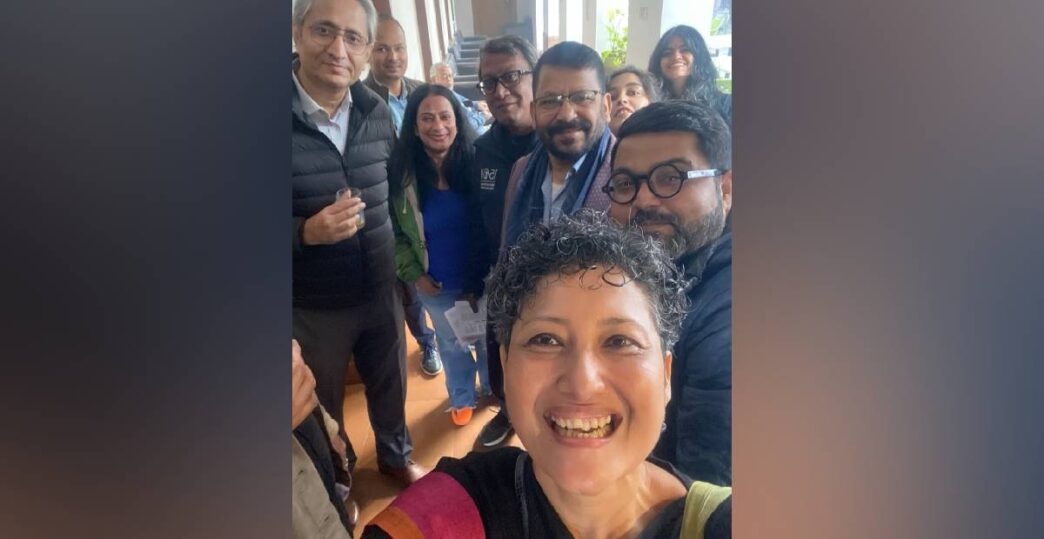
Senior journalist and writer Sangeeta Barooah Pisharoty, a daughter of Assam has been elected as the new President of the Press Club of India (PCI).
The election was held at the Press Club of India in New Delhi, with members turning up in large numbers to cast their votes. A day before the polling, Pisharoty had appealed to members to participate actively in the democratic process. “Voting about to begin at the Press Club of India. Request all members to please come to vote,” she had said, while informing members that polling would be held from 10 am to 6 pm.
Sangeeta Barooah Pisharoty is a well-known name in Indian journalism. She is currently the National Affairs Editor with the digital news platform The Wire and is based in New Delhi. Before this, she served as a Special Correspondent with The Hindu, where she reported extensively on politics, governance and social issues. Over the years, her work has earned respect for its depth, clarity and strong ground reporting. 
Pisharoty is also widely recognised for her writing on Assam and the Northeast. Her debut book, Assam: The Accord, The Discord, documents the Assam Movement, the Assam Accord and the complex insurgencies in the state. The book has received critical acclaim for its careful research and balanced narrative, and it continues to be an important reference for readers seeking to understand Assam’s modern political history.
Her reporting has not been limited to one region or one theme. In 2011, she received a fellowship from the Centre for Development Studies following her impactful series on the loss of livelihoods caused by soil erosion on Majuli island in Assam. The stories highlighted the human cost of environmental damage and brought national attention to the crisis faced by riverine communities.
In 2017, Pisharoty was honoured with the Ramnath Goenka Excellence in Journalism Award for her reportage on housing segregation between Hindus and Muslims in Delhi. The work was noted for its sensitivity and strong use of data and field reporting, and it underlined her commitment to telling stories that reflect social realities.
An alumna of Guwahati University, from where she graduated in 1995, Pisharoty began her journalism career with the national news agency United News of India (UNI). She made history there by becoming the first woman from Northeast India to be employed at UNI’s New Delhi headquarters, a milestone that opened doors for many young journalists from the region.
The Press Club of India, located in the heart of Lutyens’ Delhi, has long served as a meeting point for journalists covering Parliament, ministries and national affairs. It is a space where reporters, editors and correspondents come together to discuss professional issues, press freedom and media ethics.
The idea of setting up the Press Club of India dates back to the early 1930s and was first conceived by eminent editor and veteran journalist Durga Das. Inspired by the London Press Club during a visit to the UK, he sought to establish a similar institution in Delhi. After years of effort, the Press Club of India was finally founded on December 20, 1957, and incorporated as a company on March 10, 1958.
The club was inaugurated on February 2, 1959, by the then Union Home Minister G B Pant, at its present location. Durga Das, who was then Editor of The Hindustan Times, became its first President, while veteran journalist D R Mankekar was elected the first Secretary General. The club began functioning from a small room with just 30 members and gradually grew into a central institution for journalists across the country.
As per its constitution, the Press Club of India is meant to work for media-related activities and to safeguard the professional interests of journalists. Over the decades, it has hosted debates, press conferences, discussions and cultural events, becoming an important part of India’s media landscape.