
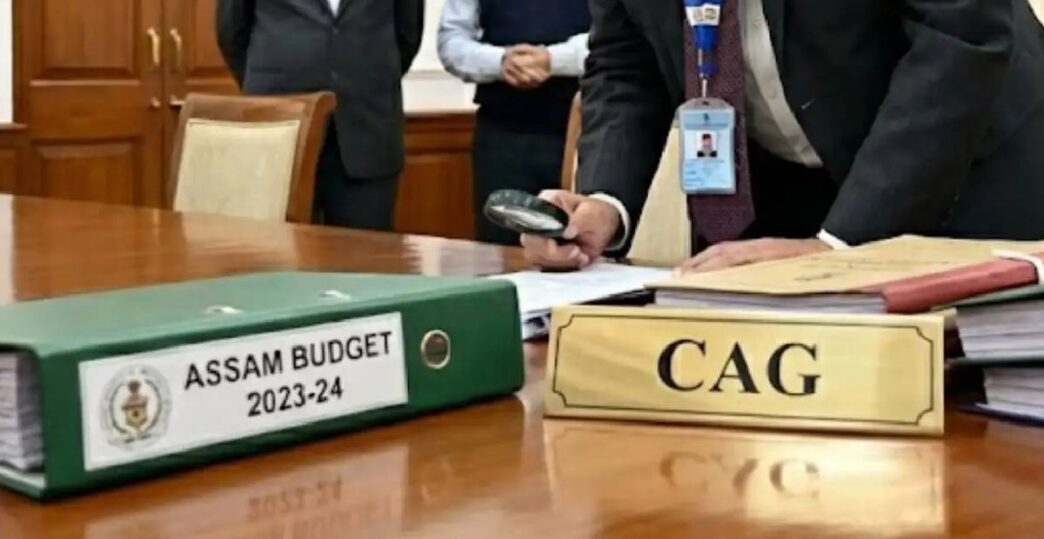
The Comptroller and Auditor General (CAG) has issued one of its strongest warnings yet to the Assam government, describing the 2023–24 State Budget as “unrealistic and overestimated,” and exposing a wide network of financial lapses that stretch far beyond flawed budgeting. The audit makes it clear that Assam’s budgetary structure is suffering from deep-rooted weaknesses. While presenting the numbers before the Assembly, the government showed spending of Rs 1,39,449.66 crore against total grants and appropriations of Rs 1,69,966.13 crore, suggesting savings of Rs 30,516.47 crore. But the CAG’s analysis reveals that these savings were largely notional because the government had overestimated its total receipts. Against an expected income of Rs 1,65,215.70 crore, the state managed to collect only Rs 1,38,830.79 crore. The gap between anticipated and actual receipts means the so-called savings never existed in real terms. The audit notes that such faulty estimates distort the state’s financial planning and create an inaccurate picture of fiscal health.
Compounding the problem, the government surrendered only Rs 107.08 crore—barely 0.35 per cent of the total “savings.” This prevented funds from being reallocated to departments that could have utilised them. The CAG says this reflects weak coordination, poor monitoring and an inability to assess actual financial requirements. Several supplementary grants were rushed through despite being unnecessary. Out of the Rs 30,210.86 crore in supplementary provisions approved during the year, only 74.19 per cent was genuinely required. The CAG says seeking additional grants without adequate justification indicates inefficient budget planning and poor internal financial control. Some departments overspent under specific heads while saving excessively under others, revealing uneven resource management and weak oversight.
However, the CAG’s most worrying findings do not come from the state budget alone. A separate audit of Assam’s State Public Sector Enterprises (SPSEs) shows that the financial stress extends deep into the structure of government-controlled corporations and companies. The report exposes chronic failures across 52 SPSEs, including power companies, transport corporations, warehousing bodies and IT undertakings. As of 31 March 2023, a staggering 485 annual accounts from 75 autonomous bodies were pending. Additionally, 245 accounts from 39 public sector undertakings had not been submitted. This means that for years, key government-run institutions have not provided updated financial records, undermining transparency and accountability. Despite this, the government continued to invest Rs 1,976.37 crore in 19 SPSEs during periods when their accounts were not updated. The CAG says investing public money without current financial statements is a serious risk and reflects a breakdown of fiscal discipline. 
The report also reveals that 6,335 Utilisation Certificates (UCs) amounting to Rs 18,669.55 crore remain pending since 2005–06. These UCs are required to show whether funds given for specific schemes were actually spent for their intended purpose. Their absence leaves thousands of crores unverified and raises serious concerns about fund mismanagement and possible diversion. The CAG also highlights massive accumulated losses across SPSEs. As of March 2023, these losses stood at Rs 3,952.71 crore. Assam State Transport Corporation alone contributed Rs 1,664.06 crore to this figure, making it the single largest loss-making entity among statutory corporations. Fourteen SPSEs have losses that exceed their entire paid-up capital, signalling complete erosion of financial viability.
The power sector, which receives the bulk of state financial support, also shows signs of distress. Over three consecutive years—2020–21, 2021–22 and 2022–23—power companies absorbed 85.52 per cent, 82.21 per cent and 71.79 per cent respectively of all SPSE-related budgetary allocations. Yet despite receiving such high levels of support, the sector continues to suffer from operational inefficiencies, unresolved debts and weak internal controls. The CAG found unreconciled differences between the equity and loan figures recorded in SPSE accounts and those recorded in Assam’s Finance Accounts. There is a mismatch of Rs 5,267.24 crore in equity figures and Rs 1,795.08 crore in loan figures—an alarming discrepancy that raises questions about the integrity of the state’s financial reporting.
Some of the report’s most striking findings relate to failed or poorly executed government projects. The Tech City project under Assam Electronics Development Corporation Limited is one of the most glaring examples. The company lacked any clear funding strategy or implementation plan for the project, leading to delays of more than five years. As a result, the government suffered penal interest of Rs 2.81 crore and a massive Rs 175.57 crore of investment remained blocked without achieving its intended purpose. Similarly, two cold storage projects under Assam State Warehousing Corporation remain incomplete even after eight years, making the Rs 8.98 crore spent on them unfruitful and causing a loss of Rs 2.56 crore in potential rental income.
In the transportation sector, failures continue to mount. Assam State Transport Corporation recorded losses rising sharply from Rs 38.67 crore to Rs 106.53 crore in just one year. Operational inefficiencies, a deteriorating fleet and low revenue recovery have all contributed to its worsening financial condition. The audit also uncovers poor corporate governance across SPSEs. At least 22 government companies failed to hold the mandatory four board meetings required each year. Many lacked independent directors, and several did not have audit committees in place. The CAG states that such gaps directly weaken financial supervision and contribute to persistent mismanagement.
Taken together, the findings present a troubling picture of Assam’s financial ecosystem. The combination of unrealistic budget estimates, mounting losses in public sector enterprises, non-submission of financial statements, incomplete infrastructure projects and widespread governance failures shows that the state’s finances are under severe strain. The CAG has recommended that Assam adopt realistic budgeting practices, strengthen monitoring mechanisms, ensure timely submission of accounts and undertake strict reviews of loss-making enterprises. The audit also emphasises the need for the government to reconcile its financial records, improve corporate governance standards and enforce accountability across departments. At its core, the CAG’s message is clear: Assam must urgently reform its financial management systems to prevent deeper instability. For the people of Assam, the consequences of continued financial mismanagement may become heavier with each passing year if these warnings go unheeded.