
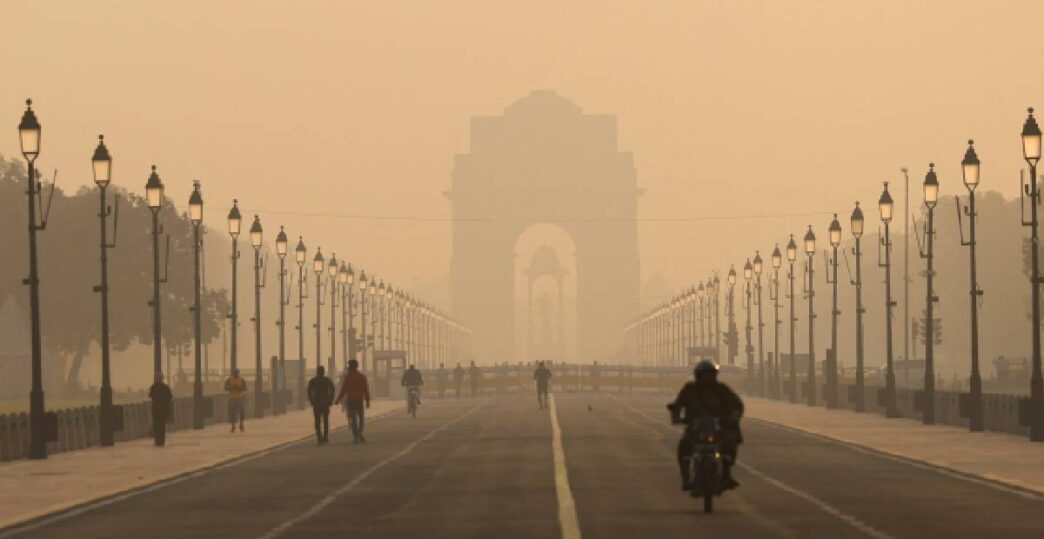
New Delhi continued to struggle under thick, toxic air on Sunday, marking the tenth straight day of very poor air quality. The situation showed no clear sign of improvement, with the city’s overall Air Quality Index (AQI) standing at 380, slightly worse than Saturday. Many parts of the capital once again recorded pollution levels in the severe range, raising concerns for public health and daily life.
Several pollution hotspots registered alarming readings early in the morning. Jahangirpuri reported an AQI of 438, placing it in the severe category. Other areas such as Bawana (431), Anand Vihar (427) and Ashok Vihar (421) also showed severe air pollution. These numbers indicate that large parts of Delhi are facing conditions that can seriously affect even healthy people.
The neighbouring cities in the NCR region faced a similar situation. Noida came close to the severe category with an AQI of 396. Greater Noida stood at 380, marked as very poor. Ghaziabad remained among the worst-hit areas with a severe AQI of 426. Meanwhile, Gurugram and Faridabad recorded lower but still unsafe levels, with AQIs of 286 and 228, both falling in the poor range. 
A shallow layer of fog covered several parts of the National Capital Region on Sunday morning as temperatures dipped, making visibility low and adding to the discomfort of residents.
In response to the worsening situation, the Commission for Air Quality Management (CAQM) has tightened restrictions under the Graded Response Action Plan (GRAP). Several pollution-control measures have now been shifted to earlier stages, which means these steps will be enforced faster as the AQI rises.
The measures include ensuring uninterrupted power supply to reduce the use of diesel generator sets, deploying more personnel at traffic congestion points, issuing air pollution alerts through newspapers and TV, and increasing CNG and electric public transport services. Authorities also aim to promote off-peak travel by adjusting fares.
Some steps that were earlier part of Stage III, which applies during very poor air quality, have now been moved to Stage II. This includes staggered office hours for government offices in Delhi, Gurugram, Faridabad, Ghaziabad and Gautam Buddh Nagar. The Centre may also consider staggered timings for its own offices.
Restrictions that were earlier expected only during Stage IV, meant for severe air quality, will now begin at Stage III. These include allowing public, private and municipal offices to work with only 50 per cent staff on-site, with the rest working from home.
The Delhi government has also directed private offices to follow similar steps and ask half of their employees to work from home. These measures are being taken to reduce traffic and curb pollution as the city continues to face dangerous air quality levels.