

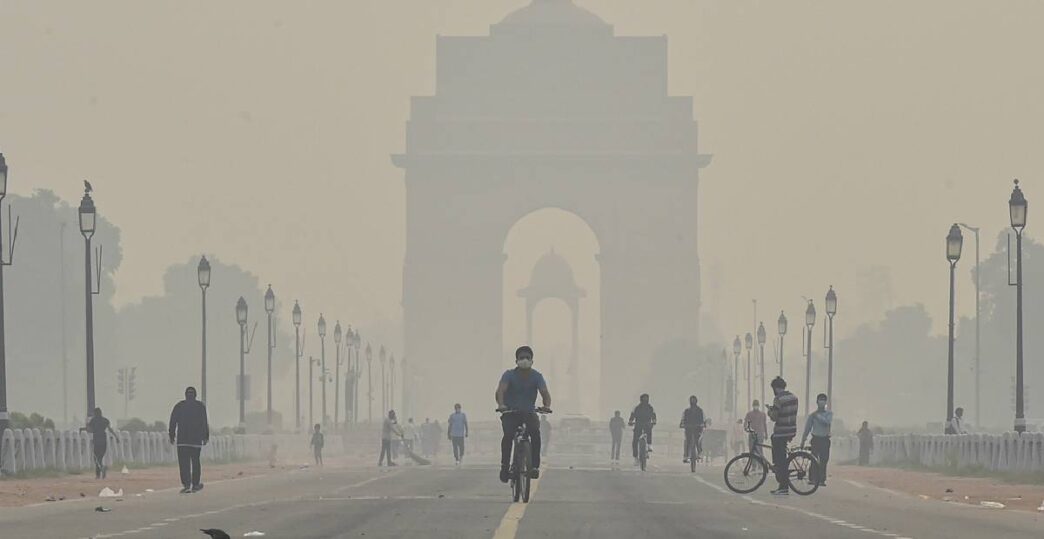
The national capital woke up to a sharp dip in temperature and another spell of heavy smog on Sunday, pushing the city’s air quality back into the ‘severe’ zone in several parts. The minimum temperature dropped to 9.7 degrees Celsius on Saturday, marking the first time this winter that Delhi has slipped below the 10-degree mark. According to the India Meteorological Department (IMD), this reading is 3.8 degrees below normal for this time of the year.
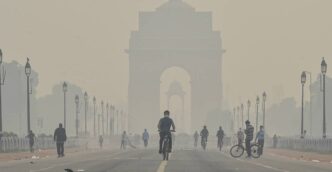
A thick layer of smog settled over the city early in the morning, reducing visibility and adding to the discomfort of residents who have been dealing with poor air for several days. Many parts of the national capital remained blanketed in haze, a scene that has become common every winter. Officials said the maximum temperature on Saturday stood at 26.6 degrees Celsius, which is also below the seasonal average by 1.9 degrees.
The IMD has forecast that Delhi will continue to see cold mornings with mist and shallow fog over the next few days. For Sunday, the minimum temperature is expected to be between 9 and 11 degrees Celsius, while the maximum is likely to remain between 24 and 26 degrees. The department also said that temperatures over the next five days will fluctuate between 8–12 degrees for the minimum and 23–27 degrees for the maximum. 
While the cold has started to settle in, the bigger concern for residents remains the quality of air. As of 8 am on Sunday, Delhi’s overall Air Quality Index (AQI) was recorded at 385, placing it in the ‘very poor’ category. However, several pockets of the city slipped into the ‘severe’ zone. Anand Vihar reported an AQI of 412, Chandni Chowk 418, ITO 417, and Bawana 436. These readings indicate that the air in these areas is hazardous and can cause serious health issues, especially for children, the elderly, and those with respiratory problems.
Saturday’s air quality also remained ‘very poor’ with an AQI of 386, similar to the levels recorded on Friday. Earlier in the week, the situation was worse. On Tuesday, Wednesday, and Thursday, the city registered AQI levels of 428, 418, and 404 respectively— all falling in the ‘severe’ category. Experts say that calm winds, falling temperatures, and seasonal pollution sources continue to trap pollutants close to the ground.
The Central Pollution Control Board classifies an AQI of 0–50 as ‘good’, 51–100 as ‘satisfactory’, 101–200 as ‘moderate’, 201–300 as ‘poor’, 301–400 as ‘very poor’, and 401–500 as ‘severe’. Officials caution that air in the ‘severe’ range can impact even healthy individuals and can significantly worsen breathing issues for vulnerable groups.