
The Election Commission of India (ECI) has confirmed that no re-polling will be conducted at any of the 45,341 polling booths that went to vote during the first phase of the Bihar Assembly elections held on November 6. After a complete verification of records and polling documents, the Commission found no evidence of irregularities or violations at any polling station.
Officials said the verification process was carried out across all 121 assembly constituencies where elections took place in the first phase. Each of these constituencies had a designated returning officer and a general observer to oversee the post-poll scrutiny. The review also saw the participation of around 455 candidates or their authorised representatives, ensuring that the process remained transparent and inclusive.
During the verification, officers carefully checked documents such as Form 17A, which records voter details and turnout on polling day. Other related records were also reviewed to confirm the accuracy of voting data. The Election Commission further ensured that the entire process was recorded on video. Once the verification was completed, all polling documents were resealed with official stamps and signatures for recordkeeping. 
Chief Electoral Officer (CEO) Vinod Singh Gunjiyal stated that the scrutiny confirmed the polling was conducted peacefully and in accordance with guidelines. “The Commission has found no grounds to order re-polling at any booth. The process was transparent and satisfactory,” he said.
According to provisional figures from the Election Commission, the first phase of polling recorded close to 65 percent voter turnout. Data from 41,943 out of the 45,341 booths has been compiled, and the final turnout figure is expected to rise slightly once the remaining data is received.
This turnout marks one of the highest participation rates in recent years for Bihar. In comparison, the 2020 Assembly elections—held during the COVID-19 pandemic—had recorded a turnout of 57.29 percent. The previous high was 64.6 percent during the 1998 Lok Sabha elections. Bihar’s first general election in 1951–52, however, saw only 40.35 percent of voters casting their ballots, reflecting how voter participation has grown steadily over time.
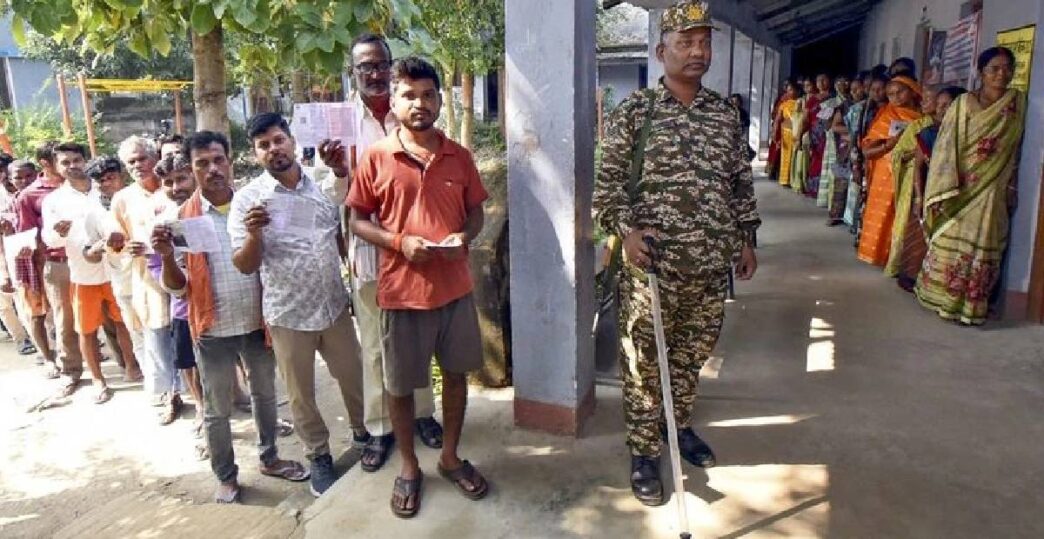
One of the most notable features of this election phase was the high participation of women voters. Election officials across districts observed large turnouts of women, especially in rural constituencies.
“A lot of enthusiasm was noticed among female voters today,” said CEO Gunjiyal. “Their active participation has significantly contributed to the high overall turnout.”
Out of the 45,341 polling stations, 36,733 were located in rural areas where women’s participation is traditionally seen as a key indicator of voter engagement.
In total, about 3.75 crore voters were eligible to cast their votes in this phase, deciding the fate of 1,314 candidates across 121 constituencies.
District-wise data showed that Muzaffarpur led with the highest voter turnout at 70.96 percent, followed by Samastipur at 70.63 percent, Vaishali at 67.37 percent, Madhepura at 67.21 percent, Saharsa at 66.84 percent, Khagaria at 66.36 percent, Lakhisarai at 65.05 percent, Munger at 60.40 percent, Siwan at 60.31 percent, Nalanda at 58.91 percent, and Patna at 57.93 percent.
Officials said the figures reflect a strong voter response across the state, particularly in districts known for traditionally moderate participation.
The Election Commission reported that the polling process remained peaceful throughout most parts of Bihar. Only a few minor incidents of clashes were reported between supporters of rival political parties in Lakhisarai and Saran districts.
The CEO said that 143 complaints were received during polling day, mostly regarding technical issues or local disputes. “All complaints were examined and resolved promptly,” Gunjiyal added.
There were reports of voting boycotts at a few booths in Buxar, Fatuha, and Suryagarha, but officials said these incidents did not significantly affect the overall turnout.
The second phase of the Bihar Assembly elections will take place on November 11, covering the remaining 122 constituencies. The counting of votes for all phases will be held on November 14.
The Election Commission said it will continue to monitor all activities closely to ensure that polling in the remaining phases is conducted smoothly and transparently.