
The crisis at Tezpur University continues to deepen as fresh protests erupt over the Ministry of Education’s latest decision to form yet another enquiry committee to probe the ongoing situation in the Central University. Students and stakeholders say the government appears to be repeating the same pattern of enquiries without delivering any concrete outcome, leaving the campus in prolonged uncertainty.
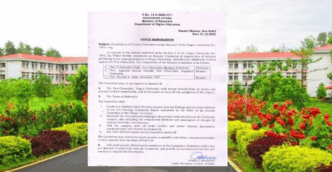
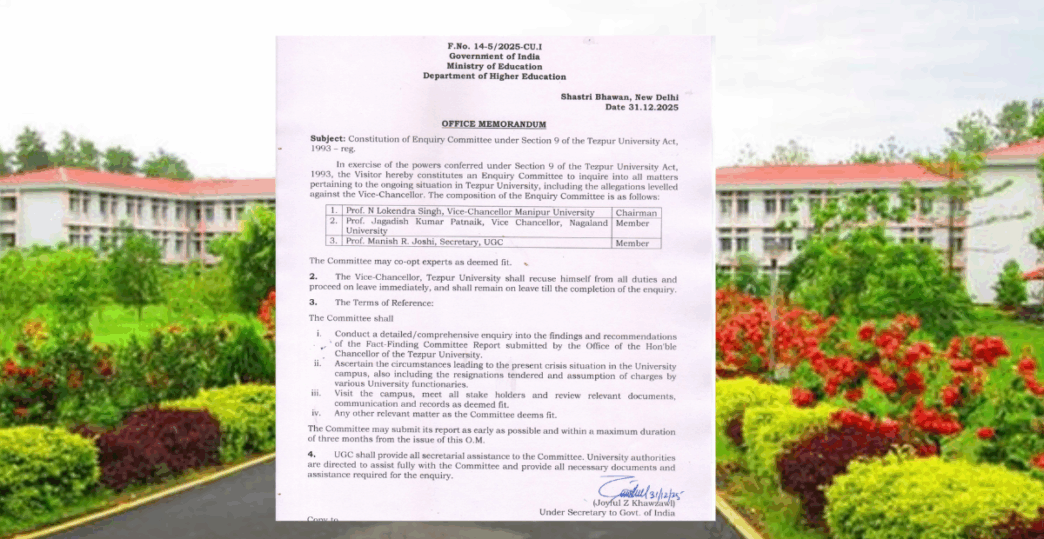
According to a recent Office Memorandum issued by the Ministry of Education on 31 December 2025, a three-member Enquiry Committee has now been constituted under Section 9 of the Tezpur University Act. The committee is headed by Prof. N Lokendra Singh, Vice-Chancellor of Manipur University, with Prof. Jagadish Kumar Pattnaik, Vice-Chancellor of Nagaland University, and Prof. Manish R. Joshi, Secretary of the UGC, as members. The notification also states that the Vice-Chancellor of Tezpur University must remain on leave until completion of the enquiry.
However, students allege that this is only the latest in a long list of committees that have been formed over the issue in recent months. Speaking to Northeast Scoop, a protesting student leader said that several enquiry bodies had already been constituted earlier, but none of them led to any resolution. He said there had first been a Presidential Enquiry Committee, but instead a Departmental Enquiry Committee was eventually provided. Prior to that, there had also been a Ministry-level enquiry committee, which again produced no result. 
The student further stated that the Ministry of Education had earlier formed a Fact-Finding Committee as well, but that initiative too failed to deliver a final decision. Even a Governor-level committee reportedly had no impact on the situation. Expressing frustration over the latest development, he said, “Now, a new three-member committee has been formed by the Ministry of Education. What they actually want to do, only God knows.”
Students say the repeated constitution of committees, without any decisive action on their findings, has resulted in a sense of fatigue and distrust on campus. They allege that while reports are prepared and meetings are conducted, no final administrative step is taken to stabilise the university. As a result, academic life has suffered and uncertainty continues to loom over students and faculty alike.
The latest enquiry committee has been tasked with examining the findings of the earlier Fact-Finding Report and reviewing the overall circumstances that led to the present crisis. It has also been mandated to meet stakeholders on campus and submit its findings within three months. But protesters question whether this will lead to anything different from the past enquiries, which they say ended without official closure.
Students and stakeholders are now openly questioning the role of the central government and the Ministry of Education in handling the situation. They argue that if multiple committees have already reviewed the matter, then the delay in action raises serious doubts about governance and accountability. Many feel that the continued dependence on inquiry mechanisms risks reducing the university’s functioning to bureaucratic paperwork rather than effective administration.
While the government has so far maintained that the ongoing enquiries are necessary to ensure transparency and fairness, students insist that the prolonged investigative process is taking a heavy toll on the academic environment. They claim that the campus climate has become tense and unstable, and that uncertainty about leadership and administrative direction is affecting both teaching and learning.
Students are now urging the Ministry of Education to make its position clear and to outline the roadmap for restoring normalcy on campus. They argue that if there are credible findings from previous enquiries, then responsibility should be fixed and corrective measures implemented. If not, the government should at least communicate transparently with the university community.