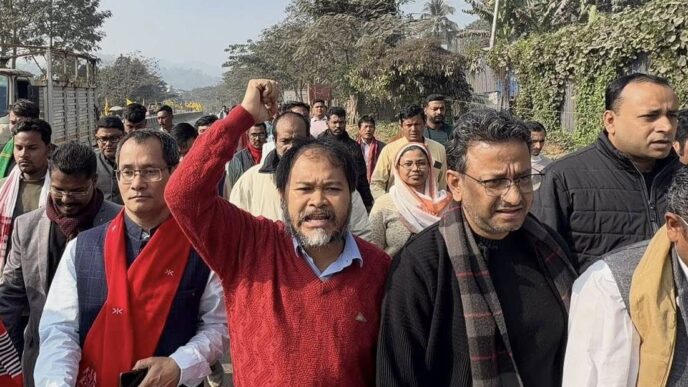

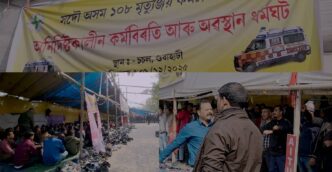
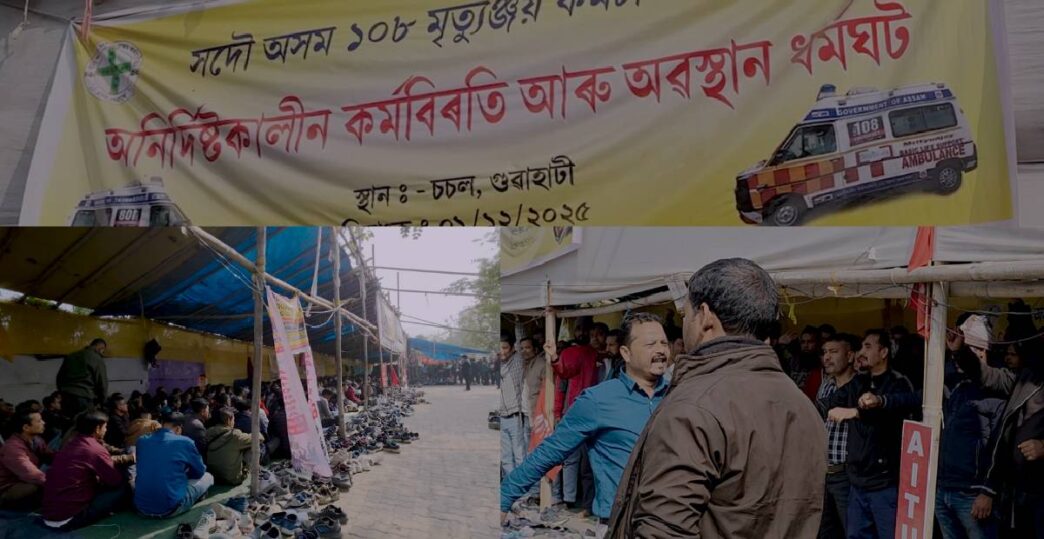
In the cold winter of Guwahati, around 3,000 workers of Assam’s 108 Mrityunjoy ambulance service are sitting under temporary tents. They are raising slogans, but their tired voices are not being heard. What started as a cry for dignity on December 1, 2025, has now turned into a hard 39-day protest, with no end in sight. These are the unsung heroes who race through treacherous roads, braving floods, insurgent threats and pandemics to save lives. Yet, the BJP-led government under Chief Minister Himanta Biswa Sarma treats them like disposable cogs in a broken machine, firing over 1,100 of them in a brazen display of authoritarianism. As families suffer and livelihoods fall apart, the state’s silence feels like a betrayal of the very people who keep Assam running.https://youtu.be/_UJHYbbQXkg?si=6XKD5QKrP4btL308
The 108 service, a public-private partnership operated by GVK Emergency Management and Research Institute (EMRI) since 2008, was meant to be a lifeline for Assam’s rural and urban poor. Instead, it has become a symbol of exploitation. Workers, including EMTs, pilots (drivers) and emergency response officers, are paid very little. Many earn only around Rs 14,000 a month, even after working long 12-hour shifts. Overtime pay is very small, and in many cases, it has not been paid for months.
“We work every day, in all kinds of danger,” said Pranjal Sharma, President of the All Assam 108 Mrityunjoy Employees’ Association, in an interview with Northeast Scoop. “For the last 17 years, we have risked our lives without job security or basic rights. The new laws have made things worse, and our wages are still very low.” 
Many protesters say their work is full of danger. They drive at night on broken roads, respond to accidents in rain and fog, and still face harassment from management.
“We began the protest with 3,000 workers on December 1,” Sharma said. “The government removed 1,100 employees just because they protested. We were told to return to work or lose our jobs. Is this fair?”
The government has shown little concern. Officials say the ambulance service handled more than 23,000 cases in December, with a record 1,399 cases in one day. They claim this proves everything is normal.
But the protesters say this is not true. “We found 370 fake cases on December 25,” Sharma said. “The numbers are being increased on paper to show the service is running smoothly, while real patients are suffering.”
At the heart of this crisis lies allegations of deep-rooted corruption within GVK EMRI. Workers point fingers at a “corrupted person named Sanjay,” who they claim has disrupted services for the past five years. “He runs only 150 vehicles during the day, none at night or on weekends,” one pilot alleged. “Fuel theft, demanding bribes from patients, unfair recruitment; it’s all under his supervision.” The association demands a probe into these irregularities, including contractual violations and mismanagement. “We’ve served Assam for 17 years,” Sharma said. “One company has been here all along, but corruption has rotted it from within. The government knows, but they protect the provider instead of us.”
Meetings with top officials have been a farce. Protesters met Chief Minister Sarma and Health Minister Mahanta multiple times, receiving assurances that “issues will be resolved.” But as days turned to weeks, promises evaporated. “Until our demands are met, we won’t stop,” Sharma vowed. The demands are straightforward and long overdue: job regularization to convert contractual positions into permanent government roles, preventing arbitrary sackings; fair wages aligned with government standards, including annual increments and equal pay for equal work; clearance of pending dues like overtime and incentives; improved working conditions with reduced harassment, proper training, and transparency; and a thorough investigation into GVK EMRI’s alleged corruption.
Over 1000 workers have already been sacked amid the protest, fueling fears of mass unemployment in a state where jobs are scarce. The terminations, issued just days after the strike began, smack of retaliation rather than resolution. Chief Minister Himanta Biswa Sarma has refused to hold talks unless the protest is called off. This has put workers in a difficult position, as they are being forced to choose between their protest and their jobs.
The Assam unit of the All India Trinamool Congress criticised the government on social media, saying this attitude shows a dictatorial way of working instead of democratic responsibility.
Meanwhile, the BJP has remained silent on the issue, with protesters saying the government seems more focused on image than on the lives of workers and patients.
The human impact is severe. Many families are breaking under the pressure. “To run our homes, we are taking loans from others,” one worker said. “Some people are selling whatever they own—cows, grain, anything they can. We have been sitting here for many days, but the Assam government is not listening to us at all.”
These workers are vital for the state, especially during disasters and health emergencies. During the COVID-19 pandemic, they carried patients without proper protective gear, putting their own lives at risk. During floods, they walked through waist-deep water to rescue people who were trapped.
Even after doing all this, when they ask for basic rights and fair treatment, they face job losses and false claims instead of support.
This isn’t just a labor dispute; it’s a systemic failure exposing the hollowness of Assam’s development narrative. Under Sarma’s regime, flashy infrastructure projects and anti-corruption rhetoric dominate headlines, but frontline workers languish in poverty. The 108 service, funded by taxpayer money, outsources accountability to private entities like GVK EMRI, allowing exploitation to thrive.
As the protest drags on, the workers’ resolve hardens. On December 22, they marked 22 days with renewed vigor, threatening hunger strikes. By December 30, it was 30 days, with no end in sight. “We served the people of Assam for 17 years,” one technician lamented. “We have families and need job security and benefits. Why has nothing been resolved even after so many days?” The association’s sit-in, now a fixture in Guwahati, draws sporadic media attention, but the government’s radio silence speaks volumes.
In Assam, where unemployment is already high and poverty is widespread in rural areas, removing 1,100 workers during a protest has made the situation worse. Workers say this decision has pushed many families into deeper financial trouble.
The National Health Mission has dismissed the workers’ allegations as “misleading.” However, many employees say the charges used against them, such as absenteeism and fuel theft, are false and have been created only to weaken and end the protest.
The situation is deeply ironic. A service called “Mrityunjoy,” which means victory over death, is now pushing its own workers into despair. As road accidents increased at the end of the year, the pressure on the remaining staff grew even more. On December 31 and January 1 alone, ambulances attended 336 accident cases. Officials admit there have been disruptions but blame the protesting workers, while ignoring that the protest is the result of years of neglect.
The time has come for responsibility and action. The Sarma government must stop this harsh approach, take back the dismissed workers, and seriously address their demands. A proper investigation into GVK EMRI is necessary to bring transparency and restore public trust. Until that happens, Assam’s emergency services remain at risk, and the biggest crisis is the government’s continued indifference.
These workers aren’t agitators; they’re guardians. By ignoring them, the state isn’t just failing its employees..it’s endangering every citizen who might one day need an ambulance. In the words of Pranjal Sharma: “We won’t back down. Our fight is for survival.” As the protest enters its third month, the question looms: How many more lives must be upended before the government listens?