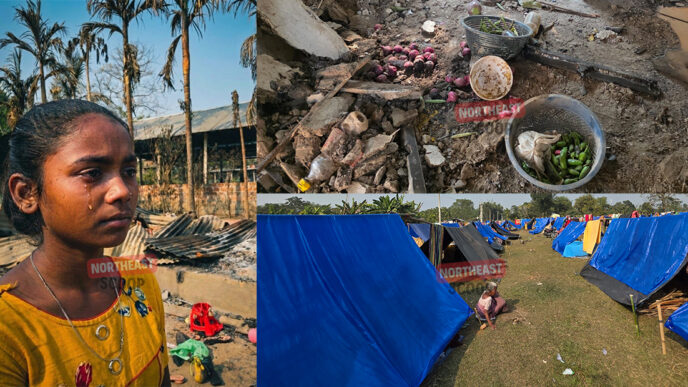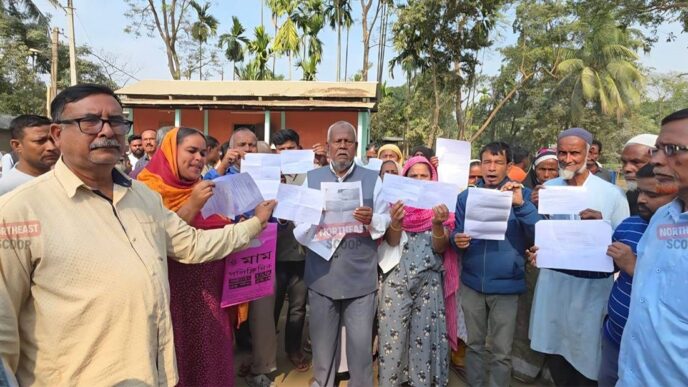

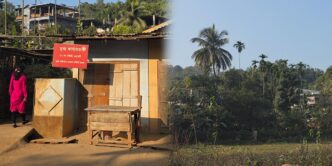
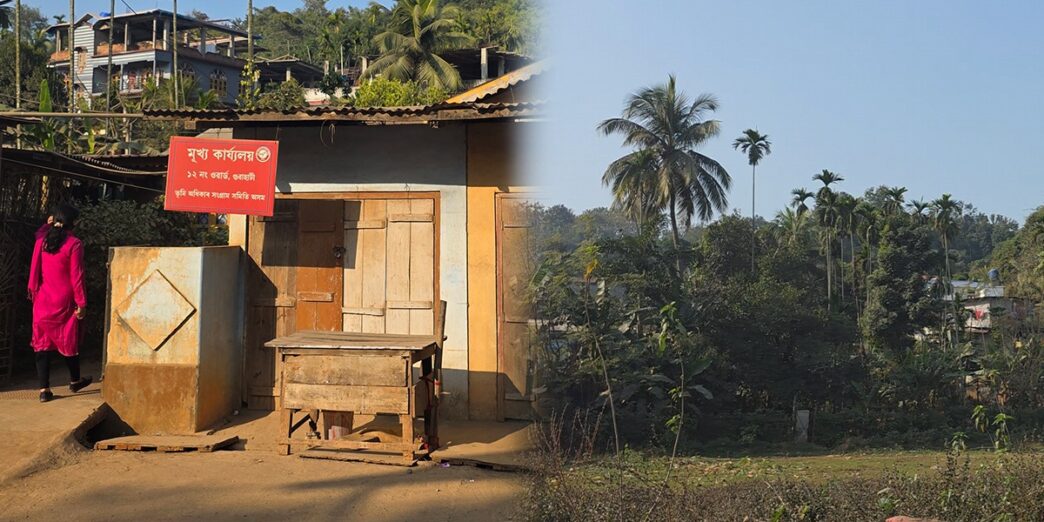
As Assam’s capital expands vertically with flyovers, malls, and smart-city promises, nearly 1.3 lakh indigenous families living across Guwahati’s 18 hills continue to live without land security, trapped in fear, uncertainty, and decades of unfulfilled political promises.
A ground investigation by Northeast Scoop reveals a disturbing reality: no proper land survey has been conducted in 12 of these hills, leaving residents without Dag Numbers, the most basic legal recognition of land ownership. Areas such as Fatasil, Gorchuk, Adingiri, Madhabdev Nagar, Ganesh Nagar, Santipur, Gotanagar, Dakhin Madhabdev Nagar, Hengrabari, among several others, remain officially “unsurveyed” despite generations of habitation.
According to locals and rights groups, nearly 85,000 families have applied for land pattas under Vasundhara 1.0, 2.0, and 3.0, but not a single family has received legal land rights.
“Survey hasn’t happened, Dag Numbers haven’t been issued, and without that, pattas are impossible,” residents said.
Prabinjyoti Kalita, leader of Bhumi Adhikar Sangram Samiti, accused political leadership of systematically using indigenous hill residents as a vote bank.
“Local MLA Ramendra Narayan Kalita has been promising land pattas for the last 25 years. Even Chief Minister Himanta Biswa Sarma promised land to indigenous people through Vasundhara. But nothing has moved beyond speeches,” Kalita said.
He pointed out that during the Guwahati Municipal Corporation (GMC) elections, the Chief Minister had promised land pattas to all families living in Guwahati’s hills, a pledge that helped the BJP win all 60 wards.
“After winning, the promise vanished. People were told to apply under Vasundhara, but surveys never happened. Many areas were later declared Non-K Land, and now a cabinet decision says Non-K land residents will not get pattas at all,” Kalita added.
‘Are We Being Treated as Bangladeshis?’
Kalita made a strong allegation against the state leadership:
“The Chief Minister speaks of Hindutva. Then why are Hindu indigenous people still denied land pattas? We are being treated like outsiders, like Bangladeshis, despite living here for generations.”
Adding to the fear, Prabinjyoti Kalita warned that evictions are planned in at least 366 locations across Guwahati, putting lakhs of indigenous residents at risk of displacement.
Indigenous Muslims Also Targeted
Pradip Sarma, General Secretary of Bhumi Adhikar Party, highlighted that the crisis cuts across religious lines.
“At Mitha Amatol, there are 11 indigenous Muslim families who have been living there even before many others. Despite this, they were served eviction notices. Only after the Gauhati High Court intervened was the eviction stayed,” Sarma said.
High Court Clears Land, Government Still Rejects Pattas
From Jyotikuchi Hills, resident Mukesh Rabha shared a painful timeline:
• 2002: Eviction carried out
• 2017: Land survey conducted following High Court orders
• 2023: High Court ruled the land does not fall under forest area
• Post-judgment: Government asked residents to apply under Vasundhara 2.0 & 3.0
• Result: Applications rejected citing “landslide-prone and vulnerable area”
“I have been living here since 1980. After 45 years, if eviction orders come, where will we go? We are indigenous. We are not asking for anything illegal. We want land pattas, nothing else,” Rabha said.
Living in Fear, Not Illegally
Residents across the 18 hills told Northeast Scoop that daily life is now governed by fear of eviction, not lawlessness.
“Until surveys happen, we will never get Dag Numbers. Without Dag Numbers, there will be no pattas. We are spending our lives in anxiety,” locals said.
The Core Question
If Guwahati’s indigenous hill residents don’t qualify for land rights after decades of residence, then who exactly is Vasundhara meant for?
Northeast Scoop will continue to track whether the government delivers land rights—or yet again reduces indigenous people to election-time promises.
Add a Comment
Keep Up to Date with the Most Important News