
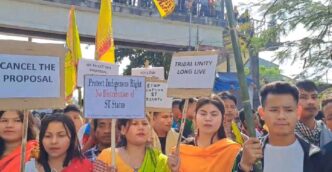
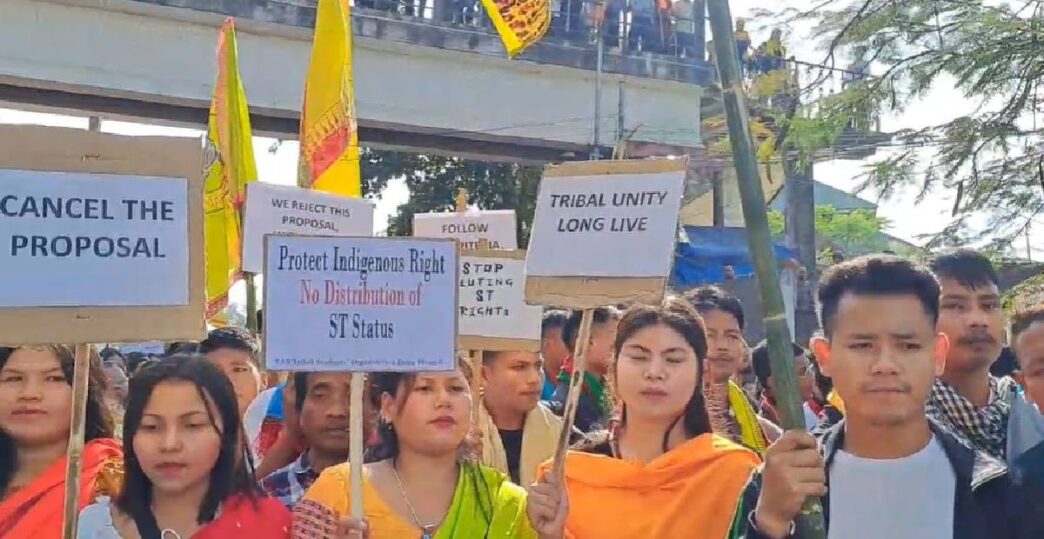
Widespread protests swept through Haflong on Wednesday as the Dimasa Students’ Union (DSU), along with several tribal student bodies, community groups and civil society organisations, held a massive rally against the Assam government’s move to grant Scheduled Tribe (ST) status to six communities of the state. The protest, one of the largest seen in recent months, reflected deep concern among the hill tribes of Dima Hasao.
The rally began at the Haflong Town Committee field, where members of the DSU, All Dimasa Students’ Union and other tribal organisations assembled in large numbers. Groups from different parts of the district joined the march, carrying placards and chanting slogans as they moved through the main roads of the town. The demonstrators demanded that the Assam Cabinet, as well as the state government, immediately withdraw the proposal to grant ST status to Tai-Ahom, Chutia, Moran, Matak, Koch-Rajbongshi and Tea & Ex-Tea Garden Tribes.
The tribal bodies said the government’s recommendation poses a serious threat to the rights, identity and political safeguards of the existing indigenous tribes of Dima Hasao. They argued that including these six communities in the ST category could disturb the social, economic and political balance in the hill district, where tribal communities already depend on limited resources and constitutional protections. 
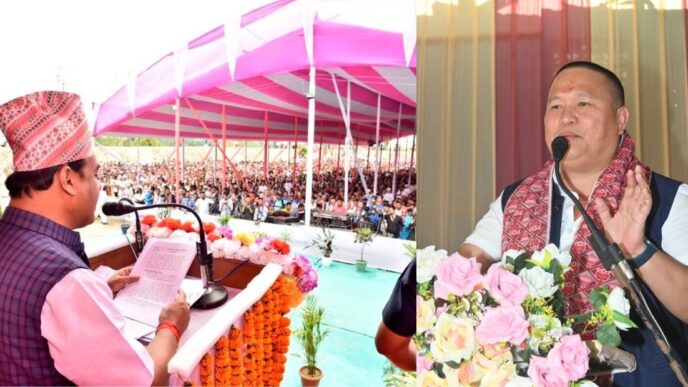
Addressing the gathering, Dimasa Students’ Union General Secretary Pramit Chengyung said the organisations stand firmly against the proposal placed before the Assembly on 27 November. He warned that the move could have long-term consequences for the tribal-majority districts of Assam. Chengyung claimed that the combined population of the six communities, estimated at nearly one crore, was being considered for political gains ahead of the 2026 Assembly elections.
He also referred to Article 244(A) of the Sixth Schedule, explaining that any proposal involving the creation of a separate Autonomous State must first be approved by the Assam Legislative Assembly before being sent to Parliament. “If such constitutional steps are followed, the 40 lakh tribal people of Assam will be willing to examine the proposal. But the government must not take decisions that dilute our rights,” he added.
Throughout the march, protestors repeatedly stressed that the rights of the indigenous hill tribes must remain the government’s top priority. They said that existing tribal groups should not be put at risk by expanding the ST list without understanding its impact on representation, employment, land rights and political autonomy.