
In 1996, a violent ethnic clash between Bodo and Adivasi communities tore through Kokrajhar and Bongaigaon districts, killing nearly 80 people and displacing over two lakh. Nearly three decades later, the district once again slipped into fear, not because of a planned conflict, but because of a misunderstanding that spiralled out of control.
On the night of 19 January, an accident in Karigaon area of Kokrajhar became the spark. A car allegedly did not respond to a local signal, hit two Adivasi youths, and soon rumours spread that the vehicle was involved in cow theft. What began as confusion quickly turned into retaliation. By 20 January, the situation worsened, highway blockades, rising tension, and houses being torched followed. Fear overtook reason.
As tensions escalated, the district administration moved to prevent further spread of violence. Kokrajhar Deputy Commissioner Pankaj Chakraborty said the situation deteriorated due to misinformation following the accident.
“After an accident, the situation turned into ethnic violence because of a misunderstanding. On January 20, the situation worsened with highway blockades and incidents of arson by miscreants,” the DC said.
To restore order, security forces were deployed across sensitive areas. The Army conducted flag marches, Rapid Action Force personnel were pressed into service, and internet services were temporarily suspended in Kokrajhar and Chirang to prevent the spread of rumours. Police presence was significantly increased to restore confidence.
“Relief camps were created for safety and shelter for both communities. At present, the situation is under control and we are moving into a peace process,” the DC added.
Following these measures, five relief camps were set up to ensure safety and prevent further clashes. When Northeast Scoop visited the ground till 22 January, a total of 2,929 people from 680 families were living in these camps.
• One relief camp housed Adivasi families
• Four relief camps housed Bodo families
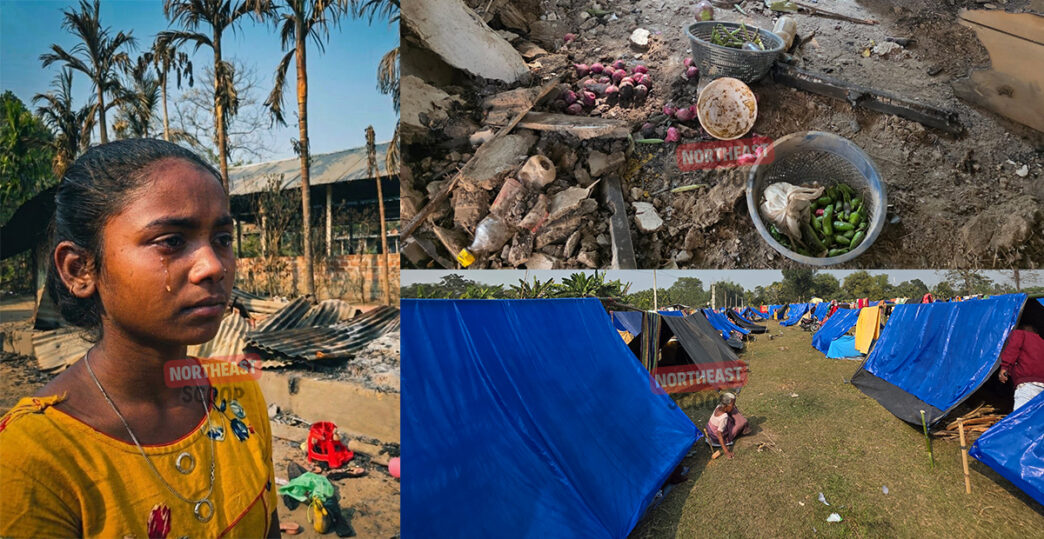
At Karigaon ME School, 99 Adivasi families, around 463 people, were taking shelter. The remaining 2,466 Bodo people were staying in four camps, including Gaujanpuri Aminpara LP School field, where many families were living under plastic tents in the biting January cold.
Despite the divide, a common sentiment echoed across camps: everyone wants to return home.
Inside the Adivasi relief camp, the most disturbing impact of the violence is visible on children, especially students preparing for board examinations.
Sonia Hemrom, a Class 12 student whose Higher Secondary exam begins on February 11, broke down while speaking to Northeast Scoop.
“I lost my home. My exams are on February 11. All my notes, dresses, documents, everything was burnt. Even our passbook. We lost everything. Only we are alive.”
She took us to what remains of her house, blackened walls, a melted Godrej cupboard, clothes reduced to ash. Even the pigs her family reared were killed.
“Police took my brother and my uncle into custody. After that, our house was burnt. My mother was cooking lunch when miscreants came and torched our home. We don’t even have clothes to wear now.”
Sonia appealed to the administration, “Please help us with documents and study materials so that we can appear for the exam.”
Nearby, Bisahok Tuddu, a Class 10 student appearing for the HSLC exam starting February 10, said:
“We are staying in the camp, but there is no environment to study. That disturbing time keeps coming back to my mind. Even though my house is safe, fear does not leave us.”
Shamila Murmu, another Class 10 student, could not hold back her tears.
“We want to appear for the exam. We request the administration to help us with documents and books. We lost everything. February 10 is my exam, what will we do?”
Poor sanitation, lack of privacy, and uncertainty have compounded trauma in the camps.
At the Gaujanpuri Aminpara LP School field, where Bodo families are sheltering under plastic sheets, the struggle is different, but fear is the same.
Parbati Mussahary, a 55-year-old woman staying in the camp, said:
“Because of the conflict, fear has entered our lives. We are staying in relief camps and suffering in the cold. We need peace. We want a police station in the border area to ensure security. Only then will we return home.”
Families here say uncertainty about safety is the biggest obstacle to returning.
Deputy Commissioner Pankaj Chakraborty said the administration is focusing on rehabilitation and recovery.
“We are in a peace process. Various organisations are coming forward to help. Students appearing for exams will be assisted in getting documents, and counselling will be provided to those in trauma and fear.”
He added that the government has announced ₹50,000 ex gratia for families whose houses were burnt and ₹5 lakh compensation for the families of the deceased.
What stands out from the ground is this: no community wants conflict. What people are asking for is safety, dignity, justice, and a chance to rebuild their lives.
A rumour turned into retaliation. Retaliation turned into fear. Fear displaced thousands, many of them children with examinations just weeks away.
As Kokrajhar tries to heal once again, the voices from relief camps carry a simple message: let misunderstanding not decide the future of children, communities, and coexistence.
Add a Comment
Keep Up to Date with the Most Important News