
NSCN (I-M) chief Thuingaleng Muivah has once again reaffirmed his organisation’s firm stand on the Naga national flag and constitution, declaring them as “non-negotiable” elements in any final political settlement with the Government of India.
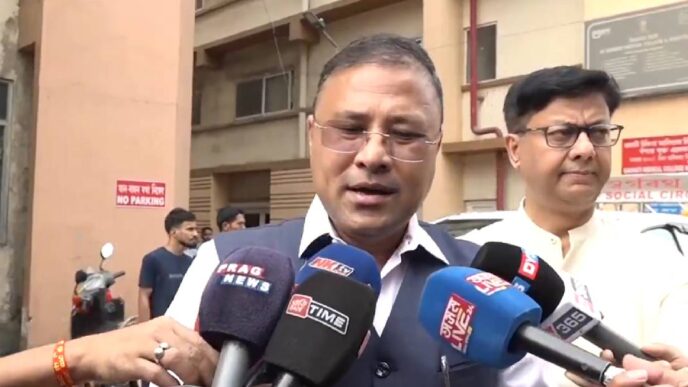
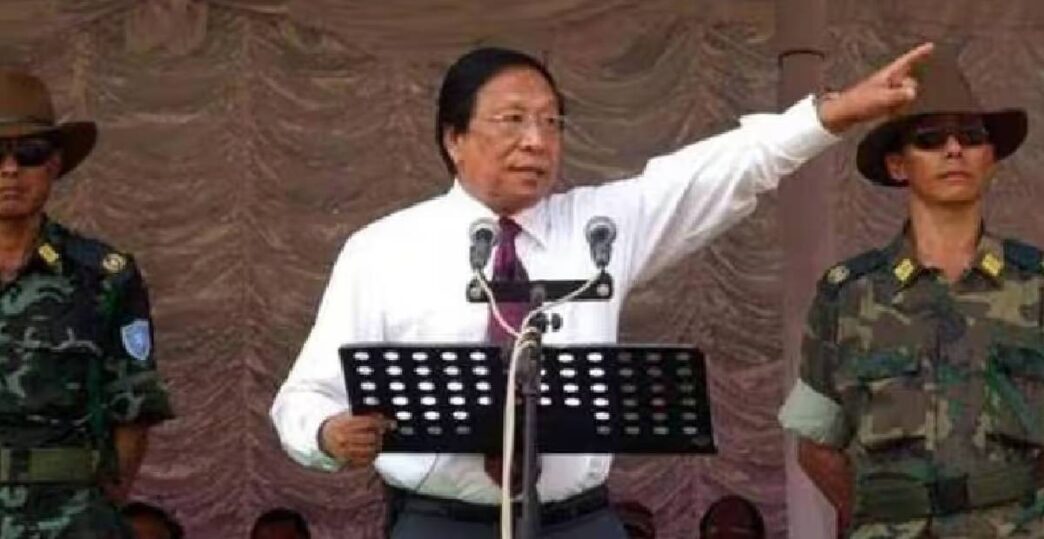
Muivah made these remarks on Wednesday while addressing a large public gathering at Senapati district of Manipur, where he was accorded a historic welcome upon his arrival by helicopter from his native village Somdal in Ukhrul district. Thousands of Naga men, women, and youth thronged the venue, waving traditional shawls and flags, and welcoming the veteran Naga leader with chants of unity and hope.
In his message, which was read out by V.S. Atem, the deputy ato kilonser of the NSCN/GPRN, Muivah expressed deep gratitude to the Naga people for their continued faith and support. “I thank the Naga people gathered here who have acknowledged and responded positively to the successful political steps taken by the NSCN/GPRN during the political conflict and in the ongoing political negotiation between the Government of India and the NSCN,” he said. 
He recalled the 28 years of political dialogue between the NSCN and the Centre, describing it as a long and difficult journey marked by endurance and patience. “The NSCN, with great endurance and perseverance, has patiently and successfully negotiated with the Government of India for the past 28 years,” he noted, adding that the organisation’s commitment and contribution remain commendable despite the many challenges faced along the way.
Muivah also paid tribute to his late comrade and NSCN (I-M) chairman Isak Chishi Swu, who co-signed the historic Framework Agreement with the Government of India on August 3, 2015. “My late friend, chairman Isak Chishi Swu, has also appended his signature in the historic Framework Agreement of August 3, 2015, which no one should violate or tarnish,” he said firmly, stressing that the agreement remains a sacred political document reflecting the unique history and identity of the Naga people.
The Framework Agreement, signed between the NSCN (I-M) and the Centre, was meant to pave the way for a lasting political solution after decades of armed conflict in Nagaland. The peace process began with a ceasefire agreement in 1997, followed by more than 80 rounds of negotiations held both in India and abroad. Despite these long years of talks, a final settlement has remained elusive, primarily due to differences over the issues of a separate Naga flag and constitution, which the Government of India has refused to accept.
Expressing regret over the Centre’s approach, Muivah said that even after the signing of the Framework Agreement, the Government of India had “continued to disregard its essence” by refusing to acknowledge the Naga national flag and constitution. “These two symbols are the heart and soul of Naga identity and sovereignty. They are not negotiable,” he emphasized.
The NSCN (I-M) leader said that the final political settlement must reflect the “uniqueness of Naga history”, and that any new political relationship with India must be based on the sharing of sovereign powers, rather than one being subordinate to the other. “The new relationship should be based on mutual respect and the recognition of two entities. It should not be bound by the constitutions of India or Myanmar but should derive from a political agreement between two sovereign entities,” Muivah said.
He said that the NSCN (I-M)’s demand for a separate flag and constitution stems from the long-standing aspiration of the Naga people to live with dignity and recognition. The organisation envisions a political arrangement that safeguards Naga rights, culture, and history, distinct from the administrative frameworks of both India and Myanmar.