
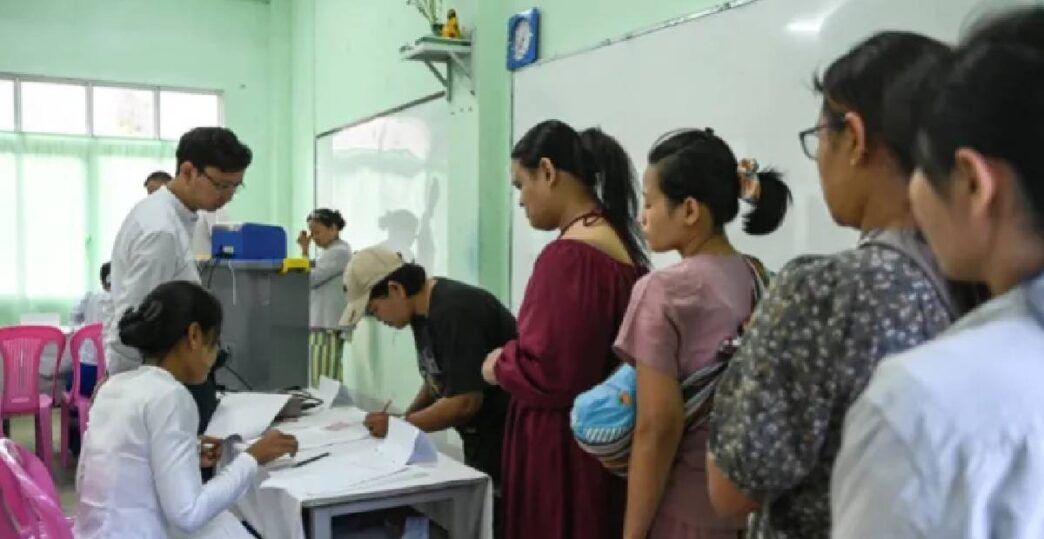
Myanmar has started voting for its national elections even as the country remains deeply divided and affected by years of unrest, political crisis and violence. The first phase of polling was held on 28 December 2025, but voting did not take place in many parts of the country because those areas are under the control of armed resistance groups and ethnic forces.
The military government led by Senior General Min Aung Hlaing currently controls only a part of the country. Many regions are run by local resistance groups that oppose the junta. Because of this, elections are taking place only in selected townships. The first phase was planned to cover 102 out of 330 townships, but turnout and coverage remain unclear.
Myanmar, a Buddhist-majority nation with over 55 million people, has been under military rule since 1 February 2021, when the army removed the elected government led by Aung San Suu Kyi and her National League for Democracy (NLD). Since then, thousands of political leaders, activists, journalists and ordinary citizens have been detained. Suu Kyi remains in prison and has received several sentences. 
The National League for Democracy, which won the last general election in 2020, is not taking part in this election. Many other parties have also been deregistered or refused registration by the military-appointed election commission. Nearly 40 political parties, including the NLD, chose not to re-register.
Only a few parties close to the military including the Union Solidarity and Development Party are contesting nationwide. Around 55 smaller parties are competing only in certain regions. Because major opposition groups are absent, many democracy activists have called this election “non-inclusive” and “unfair.”
The election will be held in three phases on 28 December 2025, 11 January 2026 and 25 January 2026 and results are expected toward the end of January. The authorities are using electronic voting machines instead of paper ballots.
Myanmar has suffered heavy loss of life and displacement since the military takeover. Reports say that around 7,500 people have died in the political conflict and about 3.6 million people have been forced to leave their homes. Military air strikes and ground operations have damaged towns, villages, hospitals and schools.
More than 22,000 political prisoners are still behind bars. Many pro-democracy figures have escaped to neighbouring countries such as Thailand, India, Bangladesh and China to avoid arrest.
Despite this situation, the junta wants to present the election as a step toward political normalcy and legitimacy.
Human rights activists and political observers say the election is being held in an environment of fear and insecurity.
Burmese journalist and activist Soe Myint, speaking from an undisclosed location, said the election is seen by many as an attempt by the military to avoid accountability for past violence.
He said there have been dozens of incidents where at least ten people were killed at a time in the past four years. He also argued that, because people do not feel safe and do not trust the military authorities, the election process cannot be considered free or fair.
In the 2020 general election, voting took place in over 95% of constituencies. The NLD won more than 80% of the seats. However, the army refused to accept the result, alleging fraud, and later detained NLD members and confiscated assets from hundreds of party workers. Suu Kyi was eventually sentenced to 33 years in prison, while former President U Win Myint received a 12-year sentence.
Regional lawmakers under the group ASEAN Parliamentarians for Human Rights (APHR) have urged ASEAN leaders to reject what they describe as a fraudulent election. They have raised concerns about rising violence and the worsening humanitarian situation.
ASEAN diplomats have continued discussions on Myanmar, including talks with Philippine foreign affairs secretary Ma Theresa P. Lazaro, who is serving as the ASEAN Special Envoy on Myanmar for 2026. The group stressed that ASEAN’s credibility is being tested, and called for stronger efforts to help the people of Myanmar.