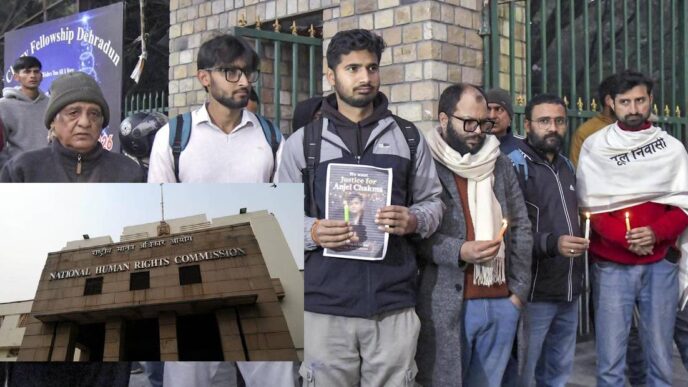

The North East Students’ Organisation (NESO) has written to Uttarakhand Chief Minister Pushkar Singh Dhami seeking strong and urgent action in the case of the death of 24-year-old Tripura student Angel Chakma in Dehradun. The organisation has also demanded stricter legal protection for people from the northeastern states living and studying in different parts of the country.
In its letter dated 30 December 2025, NESO said that it was deeply disturbed by the incident, which it described as a case of racial abuse and violence. The letter stated that Angel Chakma, a student from Tripura, was allegedly beaten and stabbed following an attack in Dehradun on 9 December 2025. After fighting for his life for more than two weeks in hospital, he died on 26 December 2025. His brother, Michael Chakma, was also reportedly assaulted during the same incident.
NESO said the attack took place “only because they looked different from the rest of the Aryan race,” and that the victims were subjected to racial slurs and insulting remarks. The organisation said such behaviour was degrading and unacceptable, and that people from the Northeast had been facing these types of incidents in various parts of the country for many years. 
The letter was signed by Samuel B. Jyrwa, Chairman of NESO, and Mutsikhoyo Yhobu, Secretary General of NESO. NESO is an umbrella organisation consisting of eight major student bodies from the northeastern states, including the All Assam Students’ Union (AASU), Khasi Students’ Union (KSU), Naga Students’ Federation (NSF), Mizo Zirlai Pawl (MZP), Twipra Students’ Federation (TSF), Garo Students’ Union (GSU), All Manipur Students’ Union (AMSU) and All Arunachal Pradesh Students’ Union (AAPSU).
In the memorandum, NESO said that people from the Northeast often face racial comments, stereotyping and harassment in different cities. According to the organisation, these situations sometimes turn violent and even fatal, as seen in the present case. NESO said it strongly condemned the attack and called it “atrocious,” adding that such acts create fear and insecurity among students and workers from the region.
The organisation urged the Uttarakhand Chief Minister to personally intervene and ensure that strict measures are taken to protect the lives and safety of northeastern students staying in Dehradun and other areas of the state. NESO said that security should not only be physical, but should also include mental and social security, so that students do not feel isolated or targeted.
Along with its appeal for intervention, NESO also placed three key demands before the state government and central authorities.
First, it demanded capital punishment for those responsible for the attack that led to the death of Angel Chakma. NESO said that the crime was heinous in nature and deserved the strongest possible punishment under the law.
Second, it called for the setting up of at least one special police station dedicated to handling cases linked to racial discrimination and crimes against people from the northeastern states. According to NESO, such a system would help victims feel safer when approaching the police and ensure that their complaints are handled more sensitively and efficiently.
Third, the organisation demanded the enactment of a strong law against racial discrimination, similar to an Anti-Racism Act. NESO said such a law would act as a firm legal safeguard for northeastern communities living in the rest of India and help reduce repeated instances of abuse and harassment.
The letter also reminded the Chief Minister that northeastern students travel to many parts of the country for education and work. NESO said these young people move away from their families with hope and trust, and therefore it is the responsibility of the authorities to ensure that they are not subjected to violence because of their appearance, language or culture.
NESO added that the death of Angel Chakma had caused deep pain not only to his family in Tripura but also to communities across the northeastern region. The organisation said the incident had again raised questions about the safety of northeastern students in mainland cities. It stated that firm action in this case would help rebuild trust and show that the law protects everyone equally.