
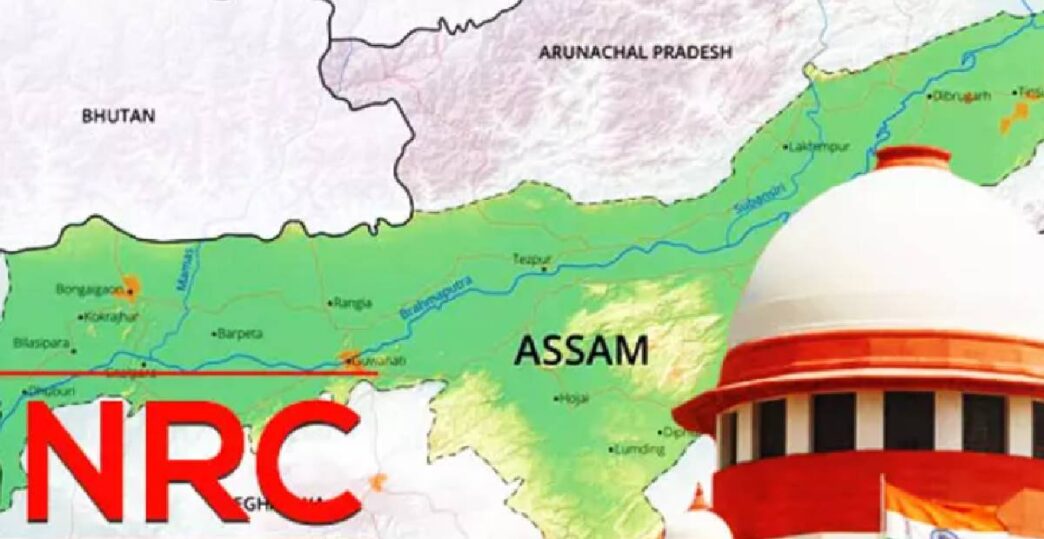
The Supreme Court on Monday issued a notice on a petition filed by Jamiat Ulama-i-Hind and the All Assam Minorities Students’ Union (AAMSU) seeking directions to the Centre and the Registrar General of Citizen Registration to complete the pending process of the National Register of Citizens (NRC) in Assam.
The petitioners have requested the Court to ensure that National Identity Cards are issued to those whose names were included in the final NRC, which was published on August 31, 2019. They have also sought the issuance of rejection slips to those excluded from the list so that they can appeal before the Foreigners’ Tribunals as per law.
The plea argues that although the final NRC was made public more than six years ago, the process has remained incomplete because the government has not taken the next statutory steps. These include issuing National Identity Cards to the 3.11 crore people who were found eligible and rejection slips for the 19 lakh people left out. The petitioners claim that this delay has made the entire NRC exercise meaningless and violative of citizens’ constitutional rights under Articles 14 and 21. 
The matter was heard by a bench of Justice P.S. Narasimha and Justice A.S. Chandurkar. Senior advocates Kapil Sibal and Indira Jaising appeared for the petitioners. Jaising argued that every person whose name appears in the final NRC has the fundamental right to receive an identity card confirming their citizenship. “It is a fundamental right of a citizen to obtain an identity card declaring their Indian citizenship after being found eligible in the NRC,” she said.
At the start of the hearing, Justice Narasimha asked the petitioners about their locus standi, remarking, “Why here?” In response, Kapil Sibal reminded the Court that the Supreme Court itself had monitored the entire NRC updating process between 2013 and 2019. Jaising clarified that their petition was not to reopen or challenge the NRC but to ensure that the final step — the issuance of identity cards — is completed.
Justice Narasimha, however, observed that the petitioners might be better off approaching the concerned High Court under Article 226 of the Constitution rather than invoking Article 32. “What you are asking for is a follow-up of the statute and the judgment. That is the reason we are saying there are more reasons for you to go to the High Court,” he said.
Jaising countered by saying that the issue deserved urgent attention from the Supreme Court as it directly concerned citizenship, a matter of national importance. “There is no dispute of facts here. The exercise is complete. We only seek completion of the final step. Having been identified as citizens, people have a fundamental right to receive their national identity cards,” she argued.
She further added that since the Supreme Court had supervised the entire NRC process for nearly five years, it was appropriate for the Court to ensure that the final phase is completed. “All we ask is that the last one percent of the work be concluded. The rest, 99.9 percent, is already done,” she said.
Supporting her, Kapil Sibal said the delay has caused great uncertainty among millions of citizens. “We just want the execution of the orders so that those who are found eligible get their identity cards, and those who are not, get the right to appeal. Six years have passed, and there has been no progress,” he said.
The bench took note of the arguments and agreed to issue notices to the Union of India and the Registrar General of Citizen Registration, seeking their responses on the matter.
The NRC in Assam was published in August 2019 after years of verification and hearings under the supervision of the Supreme Court. It was meant to identify Indian citizens living in the state and exclude illegal immigrants. Of the 3.3 crore applicants, about 3.11 crore were found eligible, while around 19 lakh were left out. However, since the publication of the final list, the process has remained at a standstill, with neither identity cards nor rejection slips issued.
The petitioners have stated that the delay has left lakhs of people in uncertainty and legal limbo. Without identity cards, even those recognized as citizens face difficulties proving their citizenship in official transactions, while those excluded cannot challenge their status before the Foreigners’ Tribunals.