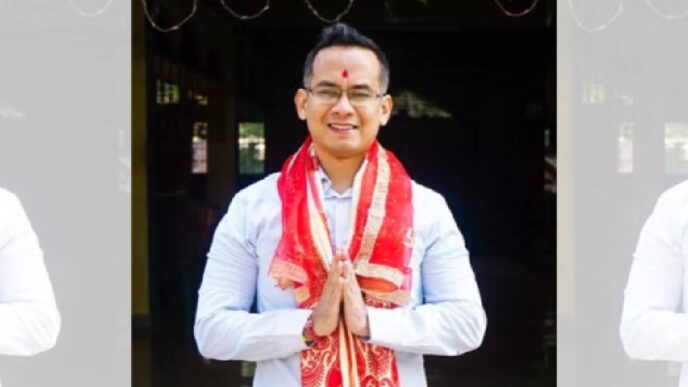


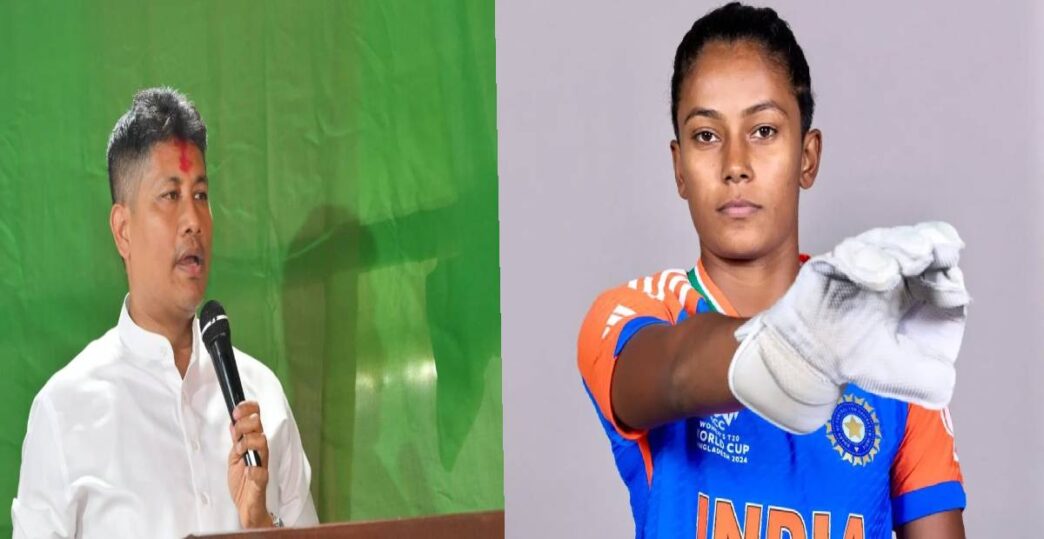
Assam’s pride and India’s newest World Cup winner, Uma Chetry, landed in Guwahati to a muted welcome — no ministers, no crowds, just a few cricket officials and airport staff draping a gamosa. Days later, BJP Minister Pijush Hazarika’s Facebook “apology” — meant to mend fences — has exploded into controversy. While Hazarika admitted it was a “mistake” not to felicitate Uma, his post quickly devolved into a political slugfest, accusing opposition leaders of the same neglect. The fallout has snowballed, with Congress’s Gaurav Gogoi, Raijor Dal’s Akhil Gogoi, and Gorkha unions calling it a “state-sponsored insult” — and the ruling BJP scrambling to contain the outrage.
In his viral Facebook post, Pijush Hazarika, Assam’s Water Resources and Social Justice Minister, wrote: “It was our mistake not to go to the airport to welcome and felicitate Assam’s pride, Uma Chetry.” Calling himself an Assamese “bowing in shame,” Hazarika seemed to offer a rare note of accountability — until the second half of his post turned accusatory. He lashed out at opposition leaders Gaurav Gogoi, Lurinjyoti Gogoi, and Akhil Gogoi, questioning why they too hadn’t gone to the airport. “Don’t you think you should apologize first instead of criticizing others?” he asked, setting off a political chain reaction.
Congress MP Gaurav Gogoi swiftly countered on X, saying, “Uma returned to a modest gathering… An opportunity lost.” Akhil Gogoi of Raijor Dal went further, calling it a “state-sponsored insult.” Even the All Assam Gorkha Students’ Union condemned the episode as a “slap to marginalized communities,” accusing the government of “selective pride” when it comes to celebrating sporting icons. 
Behind the optics lies a deeper question: how did Assam’s first woman from the Northeast to lift the World Cup trophy slip through the cracks of official protocol? Sources say the Assam Cricket Association (ACA), led by BJP MLA Taranga Gogoi, was informed in advance of the team’s schedule. Yet only junior staff turned up at the airport, citing the “late hour.” The Sports Minister Nandita Gorlosa later claimed she met Uma the following day — a gesture critics dismiss as “afterthought optics.”
The criticism cuts sharper given recent memories. In 2023, the same government rolled out a red carpet for Bollywood celebrity Sunny Leone at a film festival — a spectacle of flashing cameras and ministerial presence. In contrast, a Gorkha girl from Bokakhat, who carried Assam’s name onto the global stage, was greeted with near silence. For many, the contrast speaks volumes — about whose achievements the state chooses to celebrate, and whose it conveniently forgets.
In the end, Uma Chetry didn’t need a red carpet. She needed her state to stand up, to show up — not out of politics, but out of pride. Assam’s people did that instinctively. Its leaders, it seems, are still catching up.