

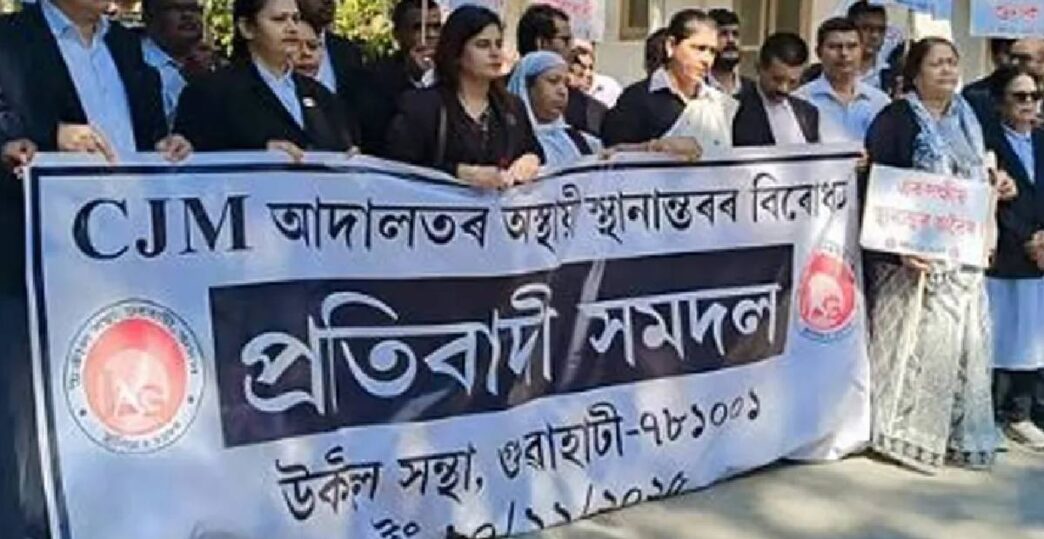
Members of the Lawyers Association, Guwahati, held a protest march on Wednesday against the temporary relocation of the Chief Judicial Magistrate (CJM) Court of Kamrup (Metropolitan) to the General Administration Department (GAD) building. The protest saw the participation of a large number of lawyers, advocate clerks, and court vendors, who expressed their strong disapproval of the decision.
The demonstrators began their march from the old CJM Court premises and moved through several important routes including Cotton University, the Sessions Court, and the Gauhati High Court, before returning to the CJM campus. The protest remained peaceful but firm in tone, as the participants carried placards and chanted slogans demanding the immediate reversal of the court shift.
Apurba Kumar Sarma, general secretary of the Lawyers Association, said that the decision to move the CJM Court was taken without consulting the legal fraternity. He stated that the association had not been informed or asked for its opinion before the government made the move. According to him, such unilateral decisions affect not only lawyers but also the public who come to the court seeking justice. 
Sarma criticized the choice of the new location, pointing out that the GAD building was never meant to function as a court. He mentioned that the building had earlier been used as a duck shed and was completely unsuitable for judicial work. “The government claims that the existing CJM Court building is unsafe and at risk of collapse, but even after the recent earthquake of 5.8 magnitude, there was no visible damage to the structure,” he said. “This makes us believe that the relocation is a deliberate move and not a necessity,” he added.
The association termed the government’s step as “arbitrary” and “ill-considered,” saying it had been taken in haste and without proper examination of the building’s condition. The lawyers also argued that shifting the court to an unfit location would make it difficult for litigants, clerks, and daily visitors who rely on accessible and functional court premises.
In response to the situation, the Lawyers Association announced a complete boycott of the CJM Court on Tuesday, November 11, as a mark of protest. They said the boycott was intended to draw attention to their grievances and to urge the authorities to review their decision.
The association also submitted a memorandum demanding several actions from the government. Their primary demand was for the immediate renovation of the existing CJM Court building to ensure it meets safety standards. They also sought the reinstatement of all subordinate courts within the old court complex so that regular judicial work can continue without disruption.
Another major demand mentioned in the memorandum was the formation of an independent commission to assess the structural safety of the old CJM Court building. The lawyers said that an expert committee’s inspection would give a factual picture of the condition and dispel any false claims about the building being unsafe.
The association further said that in the future, any plan to relocate courts, tribunals, or judicial offices should be made only after consulting the Advocate Community and the Bar Association. “Lawyers are one of the main stakeholders in the justice delivery system. Any change in the court’s functioning or location directly affects us and the public. Therefore, consultation is not only fair but also necessary,” a senior member of the association said during the protest.
Members of the Lawyers Association, Guwahati, held a protest march on Wednesday against the temporary relocation of the Chief Judicial Magistrate (CJM) Court of Kamrup (Metropolitan) to the General Administration Department (GAD) building. The protest saw the participation of a large number of lawyers, advocate clerks, and court vendors, who expressed their strong disapproval of the decision.
The demonstrators began their march from the old CJM Court premises and moved through several important routes including Cotton University, the Sessions Court, and the Gauhati High Court, before returning to the CJM campus. The protest remained peaceful but firm in tone, as the participants carried placards and chanted slogans demanding the immediate reversal of the court shift.
Apurba Kumar Sarma, general secretary of the Lawyers Association, said that the decision to move the CJM Court was taken without consulting the legal fraternity. He stated that the association had not been informed or asked for its opinion before the government made the move. According to him, such unilateral decisions affect not only lawyers but also the public who come to the court seeking justice.
Sarma criticized the choice of the new location, pointing out that the GAD building was never meant to function as a court. He mentioned that the building had earlier been used as a duck shed and was completely unsuitable for judicial work. “The government claims that the existing CJM Court building is unsafe and at risk of collapse, but even after the recent earthquake of 5.8 magnitude, there was no visible damage to the structure,” he said. “This makes us believe that the relocation is a deliberate move and not a necessity,” he added.
The association termed the government’s step as “arbitrary” and “ill-considered,” saying it had been taken in haste and without proper examination of the building’s condition. The lawyers also argued that shifting the court to an unfit location would make it difficult for litigants, clerks, and daily visitors who rely on accessible and functional court premises.
In response to the situation, the Lawyers Association announced a complete boycott of the CJM Court on Tuesday, November 11, as a mark of protest. They said the boycott was intended to draw attention to their grievances and to urge the authorities to review their decision.
The association also submitted a memorandum demanding several actions from the government. Their primary demand was for the immediate renovation of the existing CJM Court building to ensure it meets safety standards. They also sought the reinstatement of all subordinate courts within the old court complex so that regular judicial work can continue without disruption.
Another major demand mentioned in the memorandum was the formation of an independent commission to assess the structural safety of the old CJM Court building. The lawyers said that an expert committee’s inspection would give a factual picture of the condition and dispel any false claims about the building being unsafe.
The association further said that in the future, any plan to relocate courts, tribunals, or judicial offices should be made only after consulting the Advocate Community and the Bar Association. “Lawyers are one of the main stakeholders in the justice delivery system. Any change in the court’s functioning or location directly affects us and the public. Therefore, consultation is not only fair but also necessary,” a senior member of the association said during the protest.