
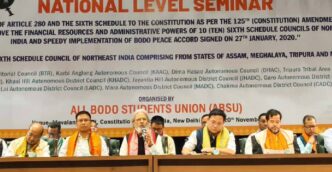
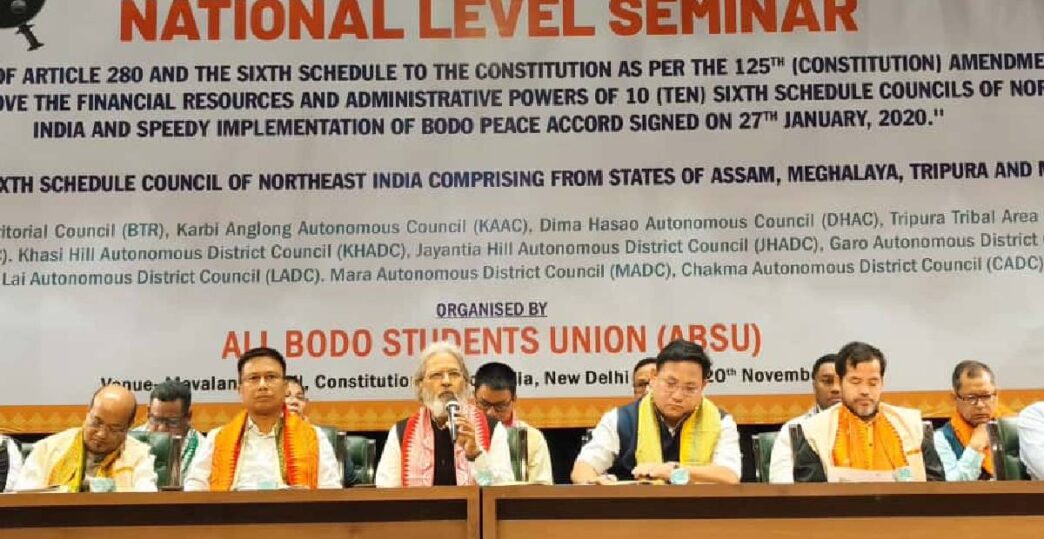
Leaders from the Northeast, including representatives of the Bodo community and other tribal groups, gathered in New Delhi today to call for urgent action on reforms under the Sixth Schedule of the Constitution and the full implementation of the Bodo Accord of 2020. The seminar, organised by the All Bodo Students Union (ABSU) at the Constitution Club of India, brought together tribal autonomous district councils, parliamentarians, constitutional experts, and movement organisations from across the region.
The programme began with tributes to Bodofa Upendranath Brahma, followed by opening remarks from Prof. Ramesh Bhardwaj, Chairperson of ABSU. Delegates included former BTR Chief Executive Member and Bodo Accord signatory Pramod Boro, Tripura Minister for Tribal Welfare Sukla Charan Noatia, former KHADC Chief Executive Member Pyniaid Sing Syiem, senior advocates Vijay Hansaria and Sabda Ram Rabha, and several other leaders representing councils from Assam, Tripura, Meghalaya, and Bodoland.
In his keynote address, ABSU President Dipen Boro highlighted the urgent need to amend Article 280 and strengthen the Sixth Schedule councils. He said these amendments determine how councils receive funds, exercise powers, and plan development at local and regional levels. While some parts of the Bodo Accord have been implemented, key clauses relating to council restructuring, village administration, land rights, and the Special Development Package remain incomplete. “The next step must come through Parliament. We appeal for the amendment to be passed in the upcoming winter session,” he said. 
Tripura’s Tribal Welfare Minister Sukla Charan Noatia stressed the importance of a stronger Sixth Schedule framework for tribal regions. He noted that although Tripura submitted a proposal in 2019 for upgraded arrangements, it has not yet been acted upon. He added that constitutional support and firm councils are essential for development and governance, citing Mizoram and Meghalaya as examples where tribal councils have contributed to progress.
Former KHADC leader Titosstarwell Chyne emphasised the need for unity among autonomous councils across the Northeast. He pointed out that more than a year has passed since assurances were given by the Union Home Ministry to form a special committee to discuss Sixth Schedule reforms. “The absence of visible results has caused concern. This seminar sends a message that tribal councils remain united in demanding meaningful amendments,” he said.
Senior Supreme Court advocate Vijay Hansaria also spoke on the necessity of translating the Bodo Accord’s commitments into tangible action. He urged the government to ensure stable funding for tribal councils so they can deliver services and plan development effectively. “Without proper financial and administrative support, councils struggle with basic duties, and the delay impacts entire regions,” he said.
Pramod Boro recalled nearly four decades of struggle and sacrifice by the Bodo people and other tribal communities. “The Bodo Accord holds the hopes of families who accepted peace in the hope of a stable future. It must not be treated like a campaign promise. It should be implemented fully,” he said, expressing hope that the 125th Amendment Bill will be taken up in Parliament soon.