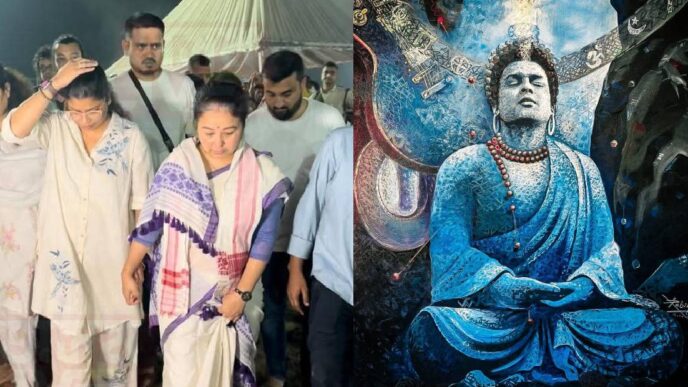


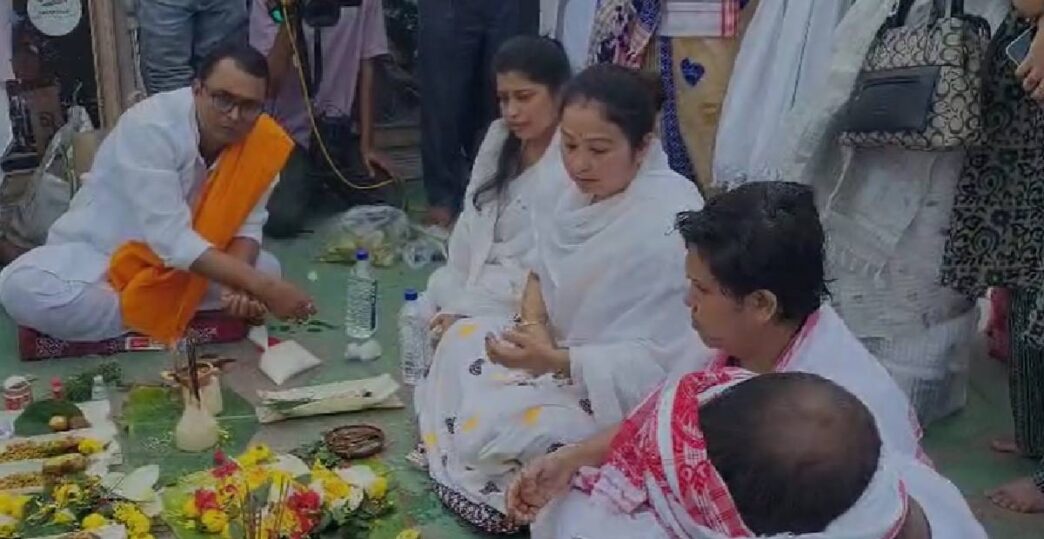
In a deeply personal farewell to the late singer-composer Zubeen Garg, his wife, Garima Garg, carried out the request he had once voiced publicly: “When I die, just immerse me in the Brahmaputra.” The rite took place at day-break on the banks of the mighty Brahmaputra River, where his ashes were laid to rest in the flowing waters of Assam, his homeland.
Zubeen Garg, aged 52, passed away on 19 September 2025 in Singapore.
In earlier interviews and public statements, Zubeen had expressed his love for his native land and its river. He asked that his remains be returned to the Brahmaputra — “the great river of Assam” — as a fitting tribute to the ties he felt with his home. According to local reports, one of his last wishes included the river’s name and his song “Mayabini Ratir Bukut” playing in tribute. 
His wife Garima, along with a small circle of family and close friends, gathered on the riverbank early this morning. With respectful gestures and silent farewells, the ashes were immersed into the current of the Brahmaputra, allowing the river to carry him away in perpetuity.
For Zubeen Garg, the Brahmaputra was not just a river; it was a lifeline, a metaphor for continuity, heritage, and belonging in Assam. His music resonated widely. He sang in multiple languages, and his popular Hindi-film song “Ya Ali” made him a household name across India.
Zubeen Garg’s legacy is multifaceted. From early albums in Assamese, to his breakthrough in Bollywood, to his various roles as music director, composer and actor — his work spanned multiple dimensions. But what many remember most is his rootedness: he never lost sight of his Assam identity.