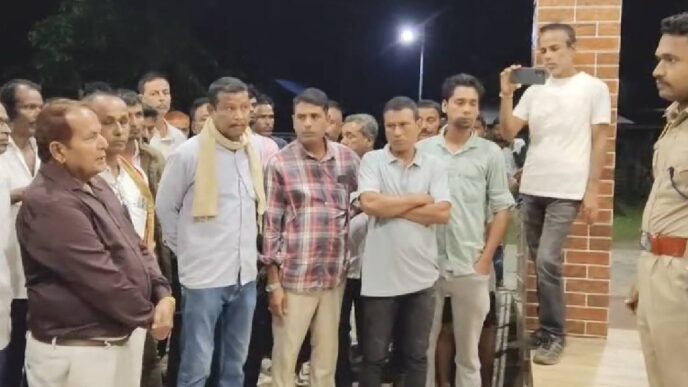

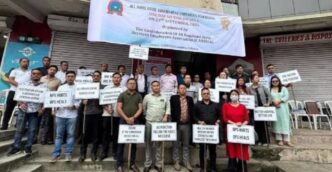
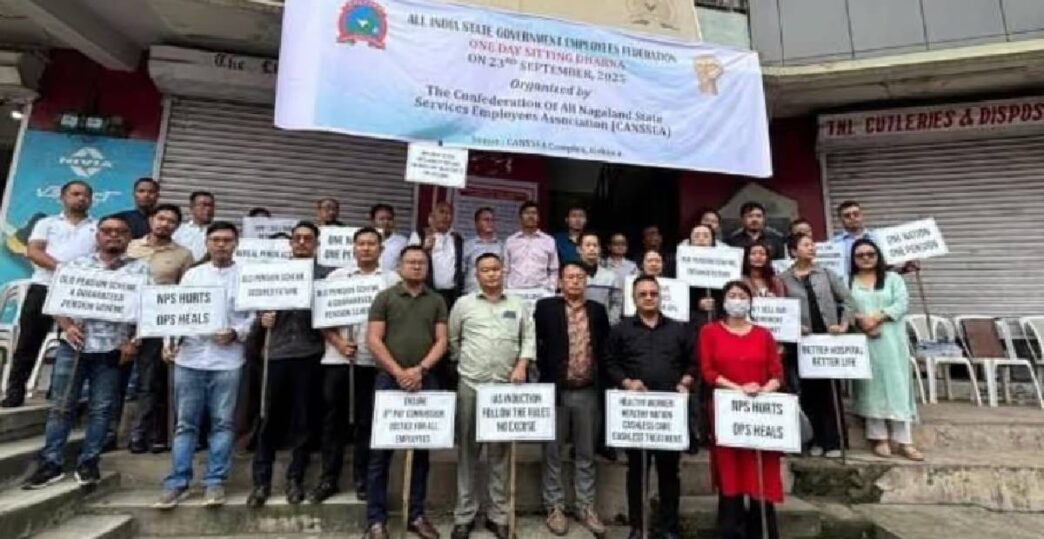
The ongoing standoff between the Joint Coordination Committee (JCC) and the Nagaland Government took a sharper turn on Thursday as the committee intensified its protest by launching a full-scale “tools down” strike across the state. This move marks an escalation from the previous “pen down” agitation, as employees from various state services joined hands to press for their demands.
The JCC, which represents several major state service associations including the Confederation of All Nagaland State Services Employees Association (CANSSEA), Nagaland In-Service Doctors Association (NIDA), Nagaland Secretariat Service Association (NSSA), Nagaland Finance and Accounts Service Association (NF&ASA), and the Federation of Nagaland State Engineering Service Association (FONSESA), said the strike was a response to the government’s continued inaction.
According to the committee, the agitation, which has entered its 40th day, will not be called off until the government restores the March 10 vacancy circular and withdraws the inclusion of a “non-NPSC/backdoor candidate” from the IAS induction list. The JCC reiterated that its protest was aimed at ensuring transparency and fairness in the IAS selection process, asserting that merit should remain the sole criterion for induction. 
In support of the movement, the All Nagaland Government Drivers’ Association, Nagaland Civil Secretariat Drivers’ Association, All Nagaland Directorate and District Government Drivers’ Union, and the Nagaland Civil Secretariat Grade-IV Staff Employees Association have also joined the “tools down” protest. However, the JCC has directed its members to maintain essential services, ensuring that ambulances, public transport, sanitation, power, and water supply remain unaffected. The committee also appealed to its members to keep the protest peaceful and confined to workplaces.
The Nagaland Government, on the other hand, has maintained that it has not violated any guidelines in the IAS induction process. Government spokesperson and Minister K.G. Kenye clarified that the practice of including at least one non-Nagaland Civil Service (NCS) officer in the IAS induction list was not new but a long-standing administrative convention.
“This is the first time we are facing such opposition to even one IAS vacancy being open to other services,” said Mr. Kenye. He added that successive governments have always nominated officers from other services who have demonstrated “outstanding merit, efficiency, and a proven record of service.” Kenye urged the JCC to reconsider its stand in the larger interest of the public and allow normal functioning of government offices. He also said that the state government would wait for the Department of Personnel and Training (DoPT) and the Union Public Service Commission (UPSC) to give their observations before taking any final decision.
“This is a matter that requires institutional clarity. We have not violated any norms. If there are differing opinions, let the Centre decide,” Kenye stated, emphasizing that essential governance should not come to a standstill due to internal disputes.
The JCC’s agitation began on September 25, initially with a symbolic protest involving black badge wearing. This was followed by a poster campaign and a pen-down strike before escalating to the current tools-down phase. The movement reflects growing frustration among state employees, who say they have exhausted all peaceful means of communication without getting a satisfactory response from the government.
As the standoff continues, government offices across Nagaland remain partially paralysed, with many departments reporting stalled administrative work. The JCC has indicated that it is prepared to continue its agitation until the government meets its demands in full.
The IAS induction row has also drawn attention from various quarters in Nagaland’s civil society, with calls for both sides to engage in constructive dialogue to prevent prolonged disruption in public services.